Carel de Moor
1655 – 1738
In short
Carel de Moor (1655–1738) was a Dutch Golden Age painter and etcher from Leiden, best known for his refined genre scenes and portraits. A pupil of Gerard Dou, he combined meticulous technique with a subtle, often intimate narrative style.
Notable works
_-_De_hengelaar_-_SK-A-640_-_Rijksmuseum.jpg)
,_by_Carel_de_Moor_(II).jpg)


Early life Born in 1655 in the university town of Leiden, Carel de Moor grew up in an environment that prized scholarship and artistic achievement. His family was part of the prosperous merchant class, which afforded him a solid education and early exposure to the visual arts. Leiden, a hub of intellectual activity in the Dutch Republic, was also home to a thriving artistic community, and young Carel would have been familiar with the works of local masters displayed in guild halls and private collections. By his teenage years, he had shown a keen aptitude for drawing, prompting his parents to arrange an apprenticeship with one of the city’s most respected painters, Gerard Dou.
Career and style De Moor’s apprenticeship under Dou, a leading figure of the Leiden fijnschilder (fine painter) tradition, profoundly shaped his artistic development. Dou’s meticulous attention to detail, smooth brushwork, and emphasis on domestic interiors left an indelible mark on de Moor’s own approach. After completing his training, de Moor established his own workshop in Leiden, where he catered to a clientele that included affluent merchants, scholars, and members of the emerging Dutch bourgeoisie. His paintings are characterised by a restrained colour palette, careful modelling of light, and an almost photographic fidelity to texture—attributes that echo Dou’s influence while allowing de Moor to explore his personal sensibilities.
Throughout the late 17th and early 18th centuries, de Moor remained active in the Dutch art market, producing a range of works from intimate portraiture to narrative genre scenes. Although the broader Dutch Golden Age was waning by the early 1700s, his output demonstrates a continuity of the classic Dutch realist tradition, even as newer Baroque and Rococo tendencies began to permeate the artistic landscape of the Netherlands. De Moor’s style can thus be described as a synthesis of fijnschilder precision with a modest embrace of the more expressive gestures that were emerging in contemporary European art.
Signature techniques De Moor’s technical repertoire includes several hallmarks that help to identify his hand. First, his use of a fine, almost invisible brushstroke creates a seamless surface where details such as fabric folds, metal glints, and skin tones blend naturally. Second, he employed a layered glazing technique, applying thin translucent layers of pigment over a detailed underdrawing; this method deepens colour saturation and gives his works a luminous quality. Third, his adept handling of chiaroscuro—subtle shifts between light and shadow—enhances the three‑dimensionality of figures and objects, a practice inherited from his master Dou. Finally, as an etcher, de Moor demonstrated a delicate line work in his prints, employing cross‑hatching to suggest texture without overwhelming the composition. These combined methods produce a visual coherence that is both precise and gently atmospheric.
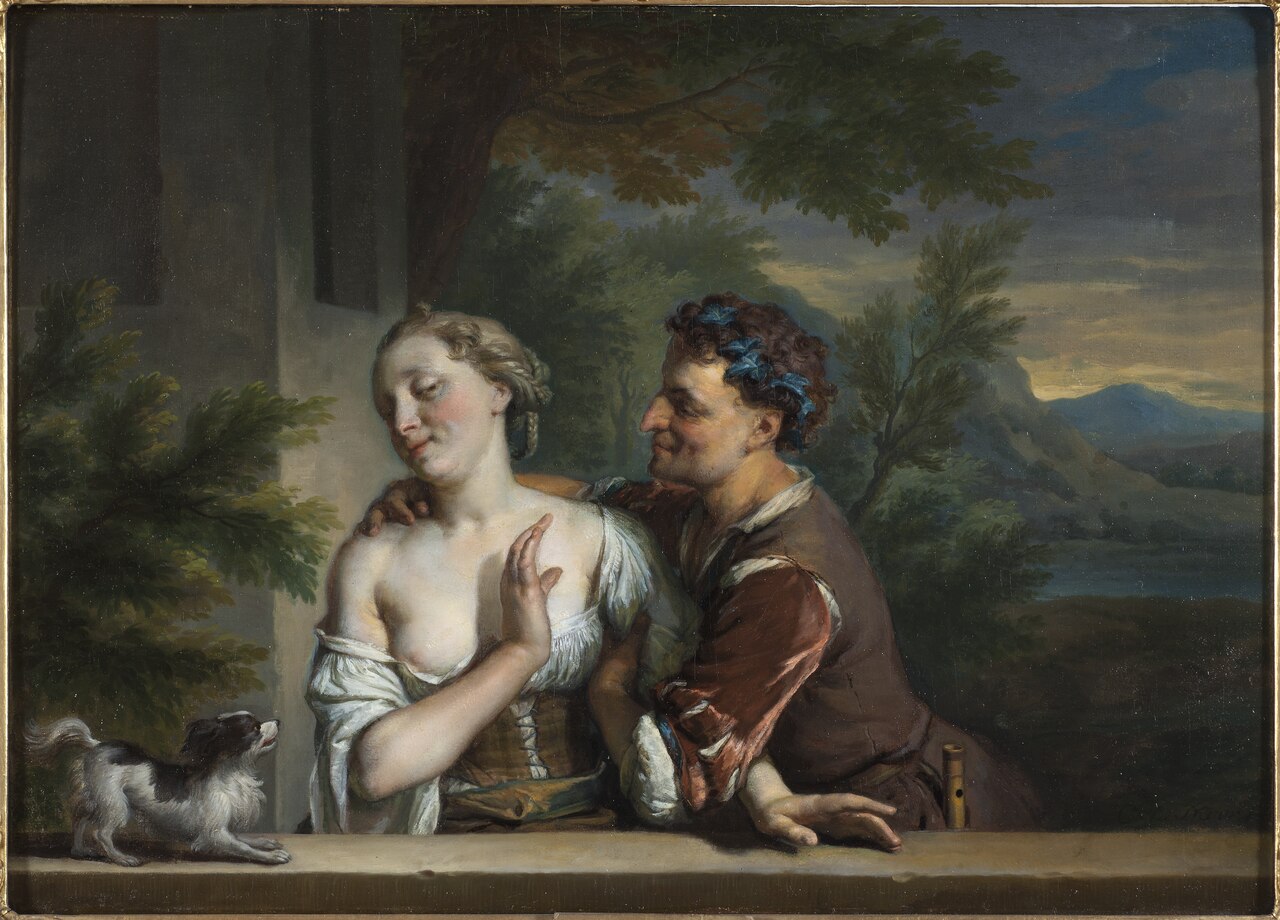
Major works Among de Moor’s surviving oeuvre, several paintings have attained particular scholarly attention. **The Angler (c. 1700)** portrays a solitary fisherman poised with his line, set against a muted, watery backdrop. The work exemplifies de Moor’s ability to render a quiet moment with psychological depth, using soft light to illuminate the angler’s focused expression. **Self‑Portrait (c. 1670)**, an early work, offers a glimpse into the artist’s self‑perception; rendered with a modest colour scheme, the portrait reveals meticulous attention to the texture of the sitter’s clothing and the reflective quality of his eyes, hallmarks of the fijnschilder approach. **Soldier Scene (1709)** captures a group of soldiers in a tavern environment, where de Moor juxtaposes the ruggedness of military attire with the refined interior details, highlighting his skill in balancing narrative content with compositional elegance. **A Man Trying to Embrace a Woman** (date unknown) presents an intimate, slightly ambiguous moment; the tender gesture and nuanced facial expressions underscore de Moor’s capacity to convey emotion through subtle gesture and light. Finally, **Portrait of a Young Gentleman (1704)** demonstrates his mastery of portraiture, with the sitter rendered in crisp detail, the fabric of his coat rendered in a delicate sheen, and a background that subtly alludes to the subject’s social status without overwhelming the figure. Together, these works illustrate de Moor’s consistent focus on human interaction, texture, and the play of light.
Influence and legacy While Carel de Moor never achieved the fame of contemporaries such as Rembrandt or Vermeer, his contribution to the continuation of the Leiden fijnschilder tradition is significant. By preserving the meticulous techniques of his master Gerard Dou well into the early 18th century, he provided a bridge between the high point of Dutch Golden Age realism and the evolving tastes of a later generation. His prints, disseminated through the growing network of Dutch printmakers, spread his refined aesthetic beyond the confines of Leiden, influencing younger artists who sought to emulate his delicate handling of line and light. Moreover, de Moor’s works have been valuable to scholars studying the transition from the classic Dutch genre painting to the more decorative styles that followed, offering a clear point of reference for the persistence of realism amid changing artistic currents. Today, his paintings are held in several European museum collections, where they continue to be cited as exemplars of quiet, technically accomplished Dutch art.
Overall, Carel de Moor remains a representative figure of a late‑Golden Age artist who, through skillful adaptation of his master’s techniques, sustained a tradition of refined, narrative-driven painting well into a period of artistic transition.
Frequently asked questions
Who was Carel de Moor?
Carel de Moor (1655–1738) was a Dutch Golden Age painter and etcher from Leiden, known for his refined genre scenes and portraiture.
What artistic style or movement is he associated with?
He is linked to the Leiden fijnschilder tradition, a meticulous, fine‑painting style that emphasises detailed texture and subtle lighting.
What are his most famous works?
Key works include *The Angler* (c. 1700), *Self‑Portrait* (c. 1670), *Soldier Scene* (1709), *A Man Trying to Embrace a Woman*, and *Portrait of a Young Gentleman* (1704).
Why does Carel de Moor matter in art history?
He helped preserve and extend the fijnschilder technique into the early 18th century, bridging the peak of Dutch realism with later stylistic developments.
How can I recognise a Carel de Moor painting?
Look for precise brushwork, a smooth surface, subtle glazing, careful chiaroscuro, and a calm, intimate narrative often featuring domestic or modestly dressed figures.