Brian Clarke
1953 – 2025
In short
Brian Clarke (1953–2025) was a British painter, architectural artist and designer renowned for his large‑scale stained‑glass and mosaic installations, bridging Neo‑Constructivist abstraction with symbolic imagery.
Notable works

.jpg)


Early life Brian Clarke was born in 1953 in Oldham, a town in Greater Manchester, England. Growing up amid the industrial landscape of northern England, he was exposed early to the interplay of light, steel, and colour that would later inform his artistic sensibility. Clarke attended secondary school with a strong emphasis on the visual arts, where he discovered a fascination with both traditional painting techniques and the emerging modernist architecture of the post‑war period. After completing his secondary education, he pursued formal studies in fine art and architectural design, gravitating toward the constructive principles championed by the Russian Constructivists and the burgeoning Neo‑Constructivist discourse of the 1970s.
Career and style Clarke’s professional career unfolded at the intersection of fine art, architecture, and design. In the late 1970s he began collaborating with architects on integrated art projects, a practice that soon defined his oeuvre. He became associated with the Neo‑Constructivist movement, which re‑interpreted the geometric rigor of early 20th‑century Constructivism through a contemporary lens, often employing vibrant colour palettes and a heightened sensitivity to light. Clarke’s work is characterised by a synthesis of abstract geometry and symbolic motifs, allowing his installations to function both as aesthetic focal points and as narrative devices within architectural spaces.
Throughout the 1980s and 1990s Clarke expanded his practice to include large‑scale stained‑glass commissions, mosaics, and set designs for theatre and opera. His collaborations with leading architects of the era—ranging from post‑modernist figures to avant‑garde designers—demonstrated his ability to translate abstract visual language into built environments. By the turn of the millennium, Clarke was recognised internationally for his capacity to fuse colour, form, and light into immersive installations that altered the perception of interior and exterior spaces alike.
Signature techniques Clarke’s signature techniques revolve around the manipulation of light through coloured glass and mosaic media. He employed a meticulous layering process, combining hand‑blown glass with digitally printed pigments to achieve depth and luminosity beyond traditional stained‑glass methods. Geometric abstraction—often based on a grid of intersecting lines, circles, and triangles—served as the structural backbone of his compositions, while symbolic imagery such as stylised flora, celestial bodies, and cultural icons were woven into the pattern to provide narrative resonance.
In mosaic work, Clarke favoured finely cut tesserae of glass, stone, and enamel, arranging them in intricate, repeating motifs that could be viewed both up close and from a distance. He also experimented with back‑lighting, embedding LED systems within glass panels to sustain a dynamic interplay of colour that shifted with ambient illumination. This technical versatility allowed his installations to respond to the changing qualities of daylight, creating an ever‑evolving visual experience.
Major works - **Abbaye de la Fille‑Dieu Romont (1268)** – Clarke was commissioned to design a contemporary stained‑glass scheme for the historic Abbey of the Daughter of God in Romont, Switzerland. While the abbey dates back to the 13th century, Clarke’s intervention introduced a modern, geometric language that respected the medieval architecture while infusing the interior with vibrant, filtered light. The work consists of a series of towering windows that juxtapose abstract colour fields with subtle symbolic references to the abbey’s monastic heritage.
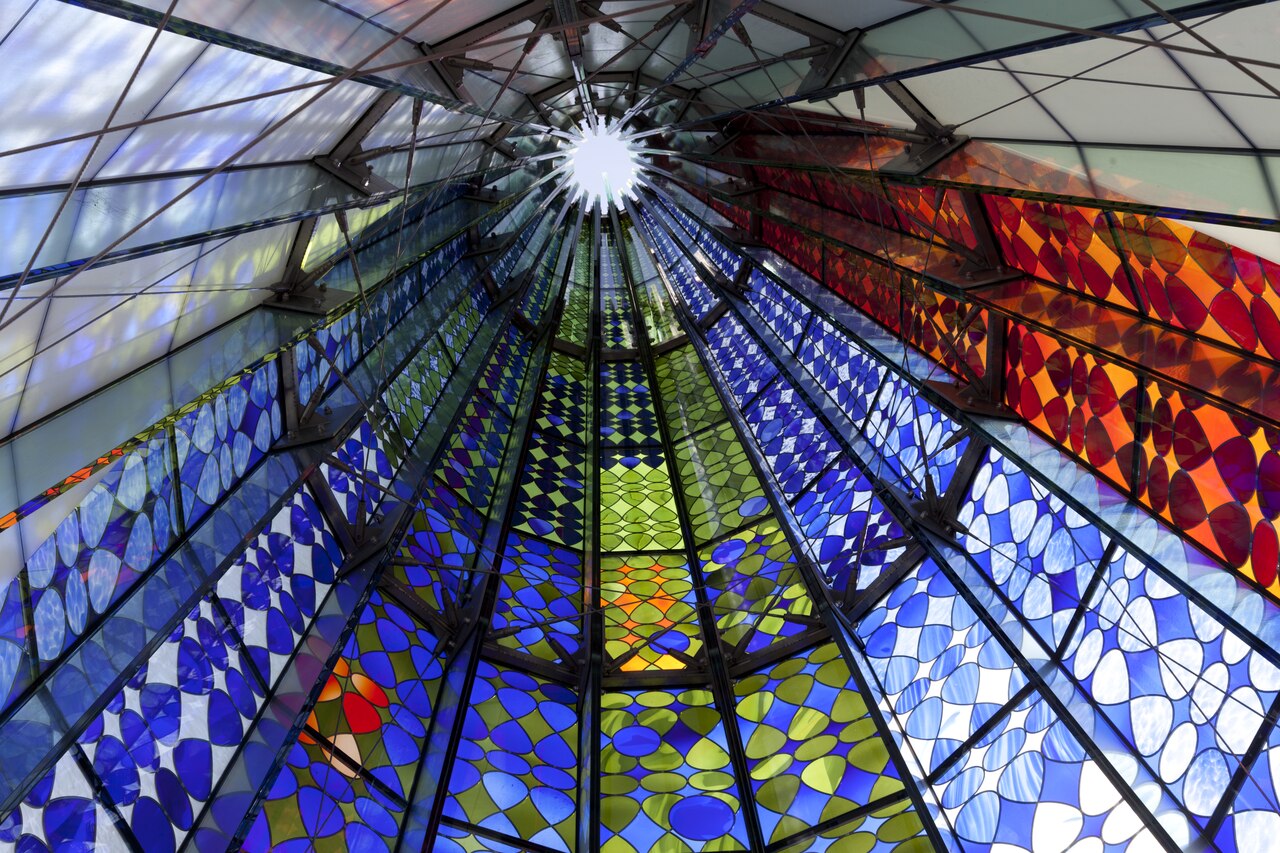
- Stamford Cone (1999) – Located in Stamford, England, the Stamford Cone is a monumental glass sculpture commissioned for a civic building. The piece takes the form of a soaring conical structure, composed of interlocking glass panels that create a kaleidoscopic effect as sunlight passes through. Clarke’s use of bold primary colours and precise geometric segmentation transforms the cone into a beacon of contemporary art within a public context.
- St Michael’s Church, Birchover (1717) – For the historic parish church in Derbyshire, Clarke created a series of stained‑glass windows that dialogue with the 18th‑century Georgian architecture. The windows reinterpret traditional religious iconography through a Neo‑Constructivist lens, employing abstracted forms and a restrained palette that harmonises with the church’s stone façade while offering a fresh visual narrative for worshippers.
- New Synagogue (Darmstadt) (1988) – Clarke’s commission for the New Synagogue in Darmstadt, Germany, involved an extensive glass façade and interior mosaic programme. The design integrates symbolic Jewish motifs—such as the Star of David and the menorah—within a lattice of intersecting planes, producing a luminous environment that reflects both spiritual tradition and contemporary artistic inquiry.
- New Synagogue Offenbach – In this later project, Clarke expanded his exploration of light and symbolism for the synagogue in Offenbach. Although the exact completion date is not publicly recorded, the installation features a sweeping glass wall that frames the sanctuary, using a palette of blues and golds to evoke a sense of sanctity and communal memory.
Influence and legacy Brian Clarke’s legacy rests on his pioneering approach to integrating abstract visual language with architectural space. By marrying Neo‑Constructivist aesthetics to the centuries‑old medium of stained glass, he revitalised an art form that had often been confined to ecclesiastical settings, extending its relevance to civic, cultural, and inter‑faith contexts. Clarke’s work influenced a generation of artists and architects who sought to incorporate colour and light as structural components rather than decorative afterthoughts.
Throughout his career Clarke also mentored emerging artists, lecturing at leading art schools and participating in international symposiums on glass art. His installations continue to be studied for their technical innovation—particularly his use of layered glass and programmable lighting—and for their capacity to transform ordinary architectural volumes into immersive, contemplative environments. Clarke passed away in London in 2025, leaving behind a body of work that remains a touchstone for contemporary discussions on the role of art within the built environment.
Frequently asked questions
Who was Brian Clarke?
Brian Clarke (1953–2025) was a British painter, architectural artist and designer best known for his large‑scale stained‑glass and mosaic installations.
What artistic movement is he associated with?
He is linked to Neo‑Constructivism, a contemporary revival of Constructivist geometry and colour.
What are his most famous works?
Key projects include the Abbaye de la Fille‑Dieu Romont windows, the Stamford Cone (1999), St Michael’s Church in Birchover, the New Synagogue in Darmstadt (1988), and the New Synagogue in Offenbach.
Why does Brian Clarke matter in art history?
Clarke re‑imagined stained glass for modern architecture, merging abstract construction with symbolic content, and influenced both artists and architects in the use of light as a structural element.
How can I recognise a Brian Clarke piece?
Look for vibrant, layered glass or mosaic panels featuring geometric grids, bold primary colours, and subtle symbolic motifs that interact dynamically with natural light.