Bernard Lens III
1682 – 1740
In short
Bernard Lens III (1682–1740) was a leading English portrait miniaturist who served as miniature painter to the courts of George I and George II. He taught miniature painting to royal children and produced a range of finely executed miniatures for aristocratic patrons.
Notable works
,_and_Their_Son_Frans_(1633%E2%80%931678)%22_MET_ep1984.442.R.jpg)



Early life Bernard Lens III was born in London in 1682 into a family of artists. His father, Bernard Lens II, was a well‑known engraver and miniature painter, and the younger Lens was trained in the family workshop from an early age. Growing up in the bustling artistic environment of early‑18th‑century London, Lens absorbed the techniques of English portraiture as well as the emerging taste for intimate, small‑scale works that could be exchanged as personal mementos among the elite.
Career and style By the first decade of the 1700s Lens had established himself as a specialist in portrait miniatures, a genre prized for its delicate detail and the personal intimacy it afforded its owners. He quickly attracted the patronage of the royal household, becoming miniature painter to King George I (reigned 1714–1727) and later to George II. In this capacity Lens produced miniature portraits for the king, the queen, and members of the court, often working from larger oil paintings supplied by court artists.
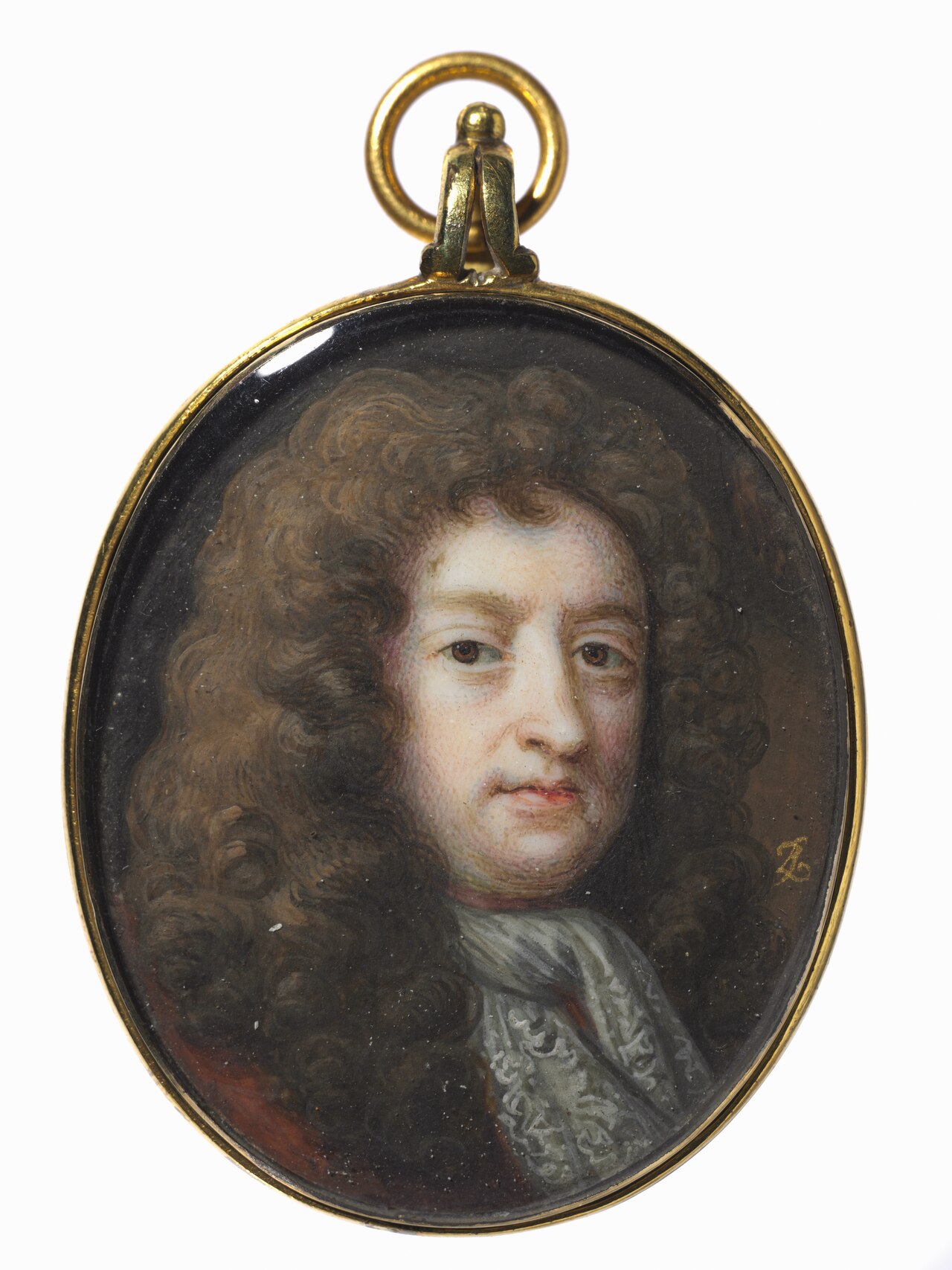
Lens’s clientele extended beyond the monarchy to include the aristocracy and the rising professional class. He was regularly commissioned by noble families to create miniature likenesses that could be set in lockets, snuff boxes, or framed panels. His work was characterised by a refined handling of flesh tones, a careful rendering of fabrics, and a subtle use of light that gave his subjects a gentle three‑dimensionality despite the very small scale of the medium.
Signature techniques Lens employed a combination of watercolour and gouache on vellum, a traditional support for miniature painting. He prepared his vellum with a thin gesso ground, then built up layers of transparent washes to model skin, before applying richer, more opaque gouache for clothing and accessories. A distinctive feature of his technique was the use of fine, almost invisible brushstrokes to suggest hair texture and the delicate rendering of jewellery, which often caught the eye of contemporary viewers.
Another hallmark of Lens’s practice was his use of a limited but carefully chosen colour palette, favouring warm ochres, soft pinks, and muted blues. This restrained palette allowed the sitter’s facial features to dominate the composition, while the background was often suggested with a faint wash of colour rather than a detailed landscape. Lens also employed a subtle glazing method to achieve depth in the eyes, a technique that contributed to the lifelike quality of his miniatures.
Major works While many of Lens’s miniatures remain in private collections, a number of his documented works illustrate his range and skill.
- Copy after Rubens, *His Wife Helena Fourment and Their Son Frans* (1721) – Lens produced a miniature replica of Peter Paul Rubens’s celebrated family portrait. By translating a large Baroque composition into a miniature format, Lens demonstrated his ability to preserve the original’s compositional balance while adapting its colouristic richness to the constraints of the medium.
- Mary Churchill, Duchess of Montague (1720) – This portrait captures the duchess in a refined pose, her dress rendered with delicate brushwork that highlights the silk’s sheen. The miniature’s subtle lighting and the careful rendering of the Duchess’s expression exemplify Lens’s talent for conveying status and personality within a compact format.
- Victorious Hero Takes Occasion to Conclude Peace (1720) – An allegorical miniature that depicts a heroic figure holding a laurel wreath, surrounded by symbols of peace. Lens’s treatment of the narrative scene shows his willingness to explore subjects beyond pure portraiture, employing his miniature technique to convey drama and symbolism.
- Portrait of Samuel Butler (1717) – A miniature of the poet and translator Samuel Butler, rendered with a restrained colour scheme that focuses attention on the sitter’s thoughtful gaze. The work is noted for its precise rendering of the poet’s attire and the subtle suggestion of a scholarly environment in the background.
- Classical Landscape with Shepherds and Shepherdess (1717) – In this work Lens departs from portraiture to present a bucolic scene. The miniature captures a serene pastoral setting with a muted palette, demonstrating Lens’s versatility in handling both figure and landscape within the miniature tradition.
These works collectively illustrate Lens’s mastery of miniature painting, his ability to adapt large‑scale compositions, and his capacity to address both portraiture and narrative subjects.
Influence and legacy Bernard Lens III’s reputation in his own lifetime was that of the pre‑eminent English miniaturist. His appointment as miniature painter to two successive monarchs affirmed his standing, and his role as instructor to royal children—Prince William, Princess Mary, and Princess Louise—ensured that his techniques were transmitted to the next generation of court artists.
Beyond his royal connections, Lens’s influence extended to the broader market for miniature portraits in Britain and the continent. Collectors and fellow artists admired his meticulous brushwork and his ability to convey the likeness and character of sitters within a tiny frame. The popularity of his miniatures contributed to the sustained demand for the medium throughout the first half of the 18th century, a period when the miniature remained a fashionable means of personal representation.
Lens’s surviving works are held in major museums, including the Victoria and Albert Museum and the National Portrait Gallery, where they continue to be studied for their technical excellence and their insight into the social networks of the Georgian elite. Modern scholars regard Lens as a pivotal figure who helped define the aesthetic standards of English miniature painting, bridging the Baroque influences of earlier continental masters with the emerging elegance of the Georgian style.
In summary, Bernard Lens III left an enduring mark on the art of miniature painting, both through his own creations and through his teaching, shaping the visual culture of his era and influencing the practice of portrait miniaturists well beyond his death in 1740.
Frequently asked questions
Who was Bernard Lens III?
Bernard Lens III (1682–1740) was an English portrait miniaturist who served as miniature painter to Kings George I and George II and taught miniature painting to royal children.
What artistic style or movement is he associated with?
Lens worked within the tradition of English portrait miniatures, blending Baroque influences with the emerging Georgian elegance, but he is not linked to a specific formal movement.
What are his most famous works?
Among his noted pieces are the miniature copy after Rubens’s family portrait (1721), the portrait of Mary Churchill, Duchess of Montague (1720), the allegorical ‘Victorious Hero Takes Occasion to Conclude Peace’ (1720), the portrait of Samuel Butler (1717), and the pastoral ‘Classical Landscape with Shepherds and Shepherdess’ (1717).
Why is Bernard Lens III important in art history?
He set the standard for English miniature painting in the early 18th century, served the royal court, instructed future court artists, and his works exemplify the technical and aesthetic qualities that defined the genre for decades.
How can I recognise a Bernard Lens III miniature?
Look for a finely rendered flesh tone, subtle glazing in the eyes, a restrained colour palette, delicate brushwork on fabrics and jewellery, and a smooth vellum surface that together create a lifelike, intimate portrait.