Benedetto Montagna
1480 – 1558
In short
Benedetto Montagna (1480–1558) was a Venetian‑born Italian engraver and painter, son of the Vicentine master Bartolomeo Montagna. He is best known for his prolific early‑16th‑century engravings, which rank him among the most important Northern Italian printmakers of his generation.
Notable works


Early life Benedetto Montagna was born in 1480 in Vicenza, a city that at the time belonged to the Republic of Venice. He was the son of Bartolomeo Montagna, the leading painter of Vicenza, who provided his first artistic training. Growing up in a workshop environment, Benedetto learned the fundamentals of drawing, composition and the preparation of panels, and he assisted his father on a number of commissions. The close familial link meant that his early visual language was heavily informed by his father's style, a fact that would later shape both his painting and his printmaking.
Career and style Around the turn of the 16th century, Benedetto began to develop his own practice as an engraver. Between roughly 1500 and 1523 – the year of his father’s death – he produced about 53 copper‑plate engravings, a volume that makes him the most prolific printmaker of his generation in northern Italy. The works display a synthesis of Venetian colour sensibility and the emerging Northern Italian interest in detailed linear design. While his paintings continued to echo his father’s compositional formulas, his prints show a greater willingness to experiment with perspective, narrative complexity and the handling of light and shade. After 1523 he inherited his father’s workshop, which he managed at least into the 1540s, though his painting output appears to have lagged behind the rapidly evolving Italian styles of the mid‑16th century.
Signature techniques Montagna’s engravings are characterised by finely incised line work that creates delicate modelling of forms. He frequently employed cross‑hatching to suggest volume and depth, a technique that allowed him to render the texture of fabrics, foliage and skin with a subtle gradation of tones. His compositions often contain multiple figures arranged in dynamic yet balanced groupings, reflecting his training in narrative painting. In many plates he used a modest but effective use of chiaroscuro, achieved solely through line density rather than shading washes, which gives his prints a clear, readable quality suitable for reproduction.
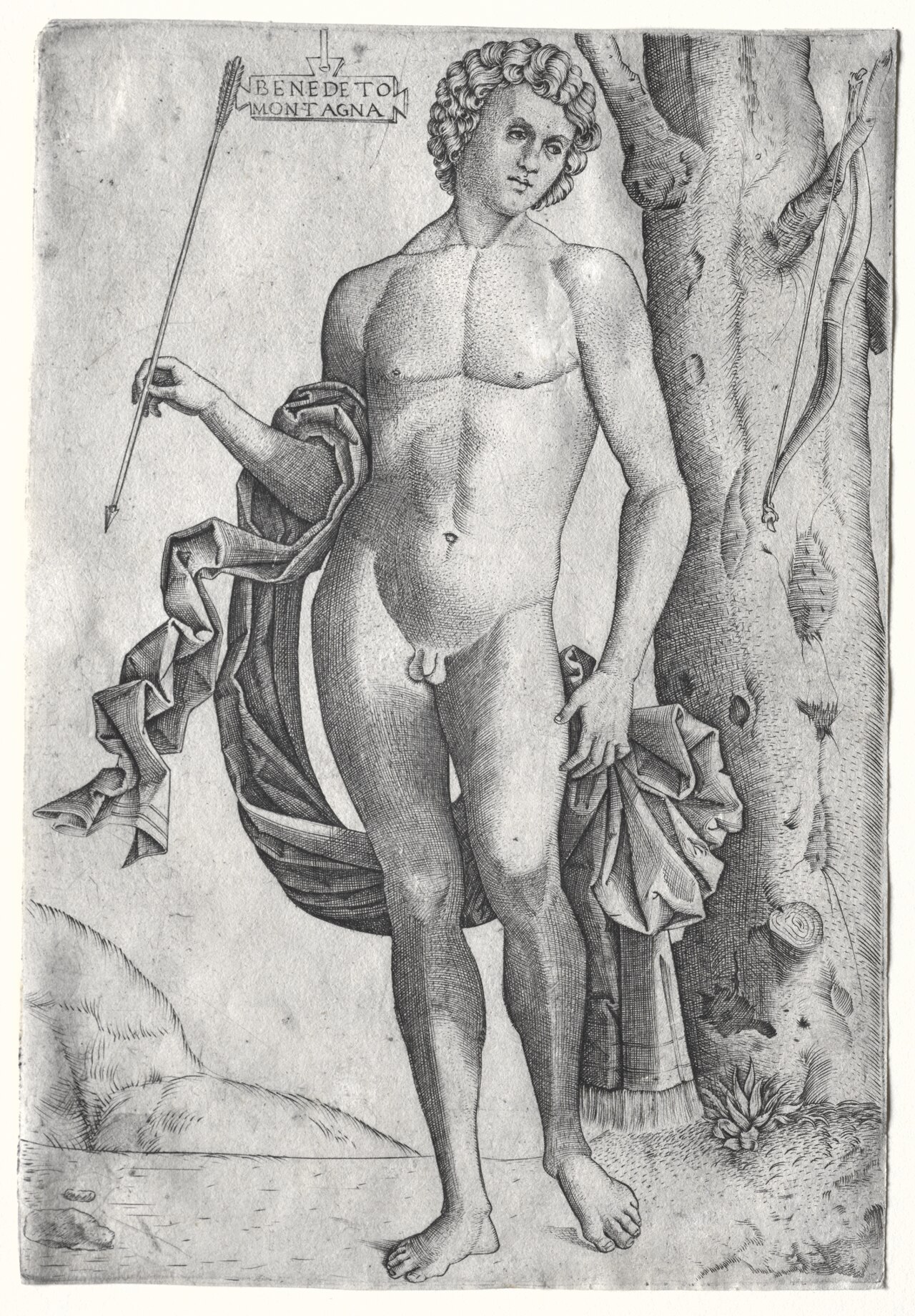
Major works - **Woman and Satyr with Two Cupids (1506)** – This early engraving showcases Montagna’s skill in rendering the human figure. The central female figure is positioned beside a satyr, with two cupids playfully interacting, creating a lively mythological scene that reveals his command of anatomical detail and expressive gesture. - **The Nativity (1507)** – In this religious composition, Montagna presents the Virgin Mary, infant Christ and attendant figures in a harmonious arrangement. The work illustrates his ability to convey sacred narrative through careful placement of characters and a restrained, yet evocative, use of line to suggest the soft glow of the holy infant. - **Satyr Family (1512)** – This print depicts a domestic scene of a satyr family, emphasizing everyday life within a mythic context. The piece is notable for its intricate detailing of the satyrs’ clothing and the interaction between the figures, reflecting Montagna’s interest in genre subjects. - **Man with an Arrow (1515)** – Here Montagna captures a solitary male figure clutching an arrow, a motif that may allude to Cupid or a hunting scene. The composition is compact, with the figure’s musculature rendered through precise hatching, highlighting the artist’s mastery of the human form. - **Birth of Adonis (1515)** – One of Montagna’s most celebrated works, this engraving portrays the mythological birth of Adonis surrounded by attendant deities. The scene is densely populated, with careful attention to drapery and the interplay of light across the figures, demonstrating his mature command of narrative complexity.
Influence and legacy Benedetto Montagna’s legacy rests chiefly on his prints, which have been valued by scholars for their technical proficiency and for providing a visual record of early‑16th‑century Venetian artistic trends. His engravings were widely disseminated, influencing fellow printmakers in the Veneto and beyond. Although his paintings did not achieve the same renown and many have been lost, the surviving works illustrate the continuity of the Montagna workshop’s style into the mid‑16th century. Modern art historians regard his prints as exemplars of the transition from the late Gothic to the early Renaissance idiom in Northern Italy, and they continue to be studied for their contribution to the development of Italian engraving.
---
Frequently asked questions
Who was Benedetto Montagna?
Benedetto Montagna (1480–1558) was a Venetian‑born Italian engraver and painter, best known for his prolific early‑16th‑century copper‑plate engravings.
What artistic style or movement is he associated with?
His work sits at the crossroads of the Venetian colour tradition and the emerging Northern Italian interest in detailed linear design, without belonging to a clearly defined movement.
What are his most famous works?
Among his most celebrated prints are "Woman and Satyr with Two Cupids" (1506), "The Nativity" (1507), "Satyr Family" (1512), "Man with an Arrow" (1515) and "Birth of Adonis" (1515).
Why is he important in art history?
Montagna is regarded as the most prolific Northern Italian engraver of his generation, and his prints are key examples of early 16th‑century Italian printmaking, influencing contemporaries and later artists.
How can I recognise a Montagna engraving?
Look for finely incised line work, extensive cross‑hatching for modelling, balanced multi‑figure compositions, and a clear, readable quality that conveys texture and light without the use of washes.