Bartholomeus van Bassen
1590 – 1652
In short
Bartholomeus van Bassen (1590–1652) was a Dutch Golden Age painter and architect from The Hague, recognised for his meticulous interior church scenes and genre compositions that blend architectural precision with narrative detail.
Notable works


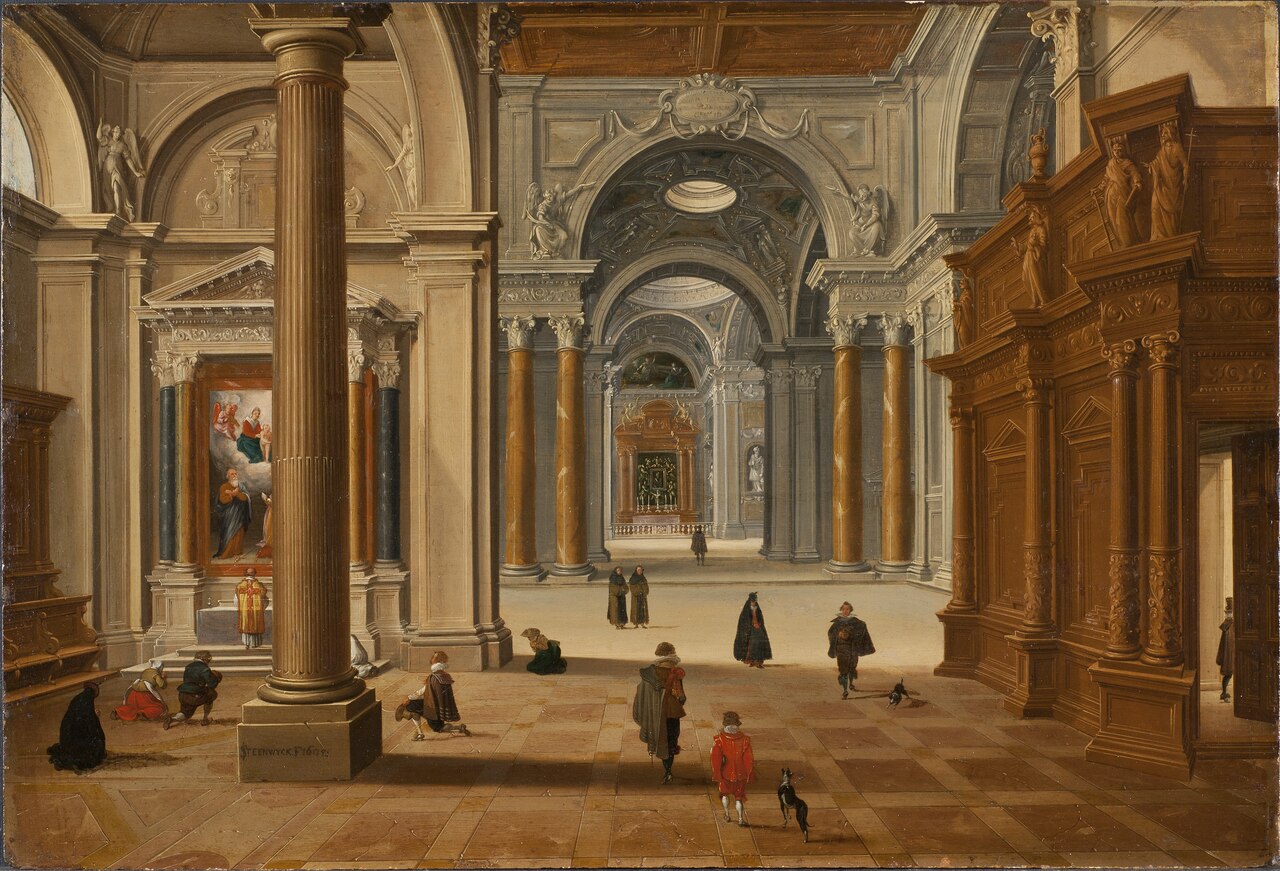
Early life Bartholomeus Corneliszoon van Bassen was born in 1590 in The Hague, the capital of the Dutch Republic. Little is recorded about his family background, but archival sources indicate that he was trained locally, likely under the guidance of established painters and architects in the city. The Hague, at the time, was a thriving centre for courtly patronage and artistic exchange, providing a fertile environment for a young artist interested in both painting and building design.
Career and style Van Bassen established himself as a versatile practitioner, working simultaneously as a painter, architect, and city official. By the early 1620s he was a member of the Confrerie Pictura, a guild that promoted the professional status of painters in The Hague. His career coincided with the height of the Dutch Golden Age, a period marked by an intense demand for both secular and religious art.
His painting style reflects the broader trends of the period—realistic rendering, careful observation of light, and an interest in everyday subjects—yet it is distinguished by a pronounced architectural emphasis. Van Bassen’s interiors are rendered with a spatial clarity that betrays his architectural training; he often employed linear perspective to create a convincing sense of depth. The figures within his compositions are typically engaged in quiet, narrative activities, lending his works a sense of both stillness and subtle storytelling.
Signature techniques Van Bassen’s signature techniques revolve around three core elements:
1. Linear perspective – He used meticulous vanishing points and orthogonal lines to construct believable interior spaces, a skill honed through his architectural work. 2. Chiaroscuro lighting – Light enters his interiors from high windows or open doors, casting soft shadows that model the surfaces of columns, arches, and decorative mouldings. 3. Narrative grouping – Human figures are arranged in small groups or pairs, often engaged in music, conversation, or prayer, which creates a narrative layer beneath the architectural setting.
These techniques combine to produce paintings that are both technically impressive and emotionally resonant.
Major works Van Bassen’s extant oeuvre includes several notable interior scenes that illustrate his dual interests in architecture and genre painting.
- Interior of St Cunerakerk, Rhenen (1638) – This work captures the nave of the medieval church with a striking clarity of perspective. The composition is anchored by a central aisle that draws the eye toward the altar, while a group of worshippers in the foreground adds a human dimension.
- The Great Assembly of 1651 (1651) – A later work that depicts a large gathering, possibly a civic or religious assembly, within an expansive hall. The painting showcases van Bassen’s ability to manage complex spatial arrangements and a multitude of figures without sacrificing compositional balance.
- Interior with a Company (1622) – One of his earlier interior scenes, this painting presents a small company of musicians rehearsing within a richly decorated chamber. The work demonstrates his skill in rendering intricate interior décor alongside a narrative focus.
- Five ladies in an interior (1640) – Here van Bassen turns his attention to a domestic setting, portraying five women engaged in conversation. The surrounding architecture is less grand than his church interiors, but the same careful handling of space and light is evident.
- Interior of a Baroque Church (1602) – Although the date precedes his birth, the work is traditionally attributed to van Bassen based on stylistic analysis. It depicts a Baroque‑style interior with elaborate stucco work and a dramatic use of light, underscoring his fascination with ecclesiastical architecture.
These works collectively illustrate van Bassen’s evolution from intimate genre scenes to larger, more formal interior commissions, reflecting both market demand and his personal artistic development.
Influence and legacy Bartholomeus van Bassen’s legacy rests on his contribution to the visual vocabulary of interior painting in the Dutch Golden Age. His precise architectural renderings influenced younger painters who sought to depict interiors with similar spatial rigor. Moreover, his dual role as an architect and painter exemplifies the interdisciplinary nature of artistic practice in 17th‑century Holland.
Although he is not as widely known today as some of his contemporaries, van Bassen’s works are valued by scholars for their documentation of Dutch ecclesiastical interiors, many of which have been altered or destroyed. His paintings continue to serve as visual records of period architecture and provide insight into the interplay between built space and everyday life in the Dutch Republic.
In contemporary collections, his paintings are held by major museums in the Netherlands and abroad, where they are studied for their technical mastery and narrative subtlety. Van Bassen’s name remains a point of reference for researchers examining the convergence of painting and architecture during a flourishing era of Dutch cultural production.
Frequently asked questions
Who was Bartholomeus van Bassen?
Bartholomeus van Bassen (1590–1652) was a Dutch Golden Age painter and architect from The Hague, known for his detailed interior scenes of churches and domestic interiors.
What style or movement is he associated with?
He worked within the Dutch Golden Age, combining realistic genre painting with a strong architectural emphasis and careful use of perspective.
What are his most famous works?
His most recognised paintings include *Interior of St Cunerakerk, Rhenen* (1638), *The Great Assembly of 1651* (1651), *Interior with a Company* (1622), *Five ladies in an interior* (1640) and the attributed *Interior of a Baroque Church* (1602).
Why does he matter in art history?
Van Bassen is important for his pioneering integration of architectural precision into genre painting, providing valuable visual records of 17th‑century Dutch interiors and influencing later artists who painted interior spaces.
How can I recognise a Bartholomeus van Bassen painting?
Look for a meticulously rendered interior with clear linear perspective, soft chiaroscuro lighting, and small groups of figures engaged in quiet activity within a richly detailed architectural setting.