António Manuel da Fonseca
1796 – 1890
In short
António Manuel da Fonseca (1796–1890) was a Portuguese painter, illustrator and theatrical designer renowned for his mythological and historical canvases. Based in Lisbon, he produced a body of work that combined academic training with a vivid narrative style, leaving a lasting imprint on 19th‑century Portuguese visual culture.
Notable works



_-_Ant%C3%B3nio_Manuel_da_Fonseca_(Igreja_de_S._Jo%C3%A3o_Baptista,_Tomar).png)
Early life António Manuel da Fonseca was born in Lisbon in 1796, during a period of political upheaval that would shape Portugal’s national identity. Little is known about his family background, but records indicate that he entered the artistic milieu of the capital at a young age, likely through apprenticeship in the workshop of the Royal Academy of Fine Arts (Academia Real de Belas‑Artes). The Academy, founded in the late 18th century, emphasized drawing from life, classical antiquity and the study of anatomy—foundations that would underpin Fonseca’s later practice. His early education coincided with the reign of Queen Maria II, a time when the Portuguese court encouraged artistic patronage to reinforce its legitimacy after the Napoleonic invasions.
Career and style Fonseca emerged as a versatile professional in the 1820s, receiving commissions for both public and private patrons. He worked for the royal household, producing portraits and ceremonial pieces, while also contributing illustrations to literary publications and designing scenery for the Teatro Nacional de São Carlos. His style reflects the academic classicism of his training, yet it is enlivened by a Romantic sensibility that favoured dramatic narratives and emotional expressiveness. Fonseca’s palette tended toward warm earth tones, with occasional bursts of saturated colour to highlight focal points. He favoured balanced compositions, often arranging figures in pyramidal or diagonal structures that guide the viewer’s eye across the canvas.
Signature techniques A hallmark of Fonseca’s technique is his meticulous underdrawing, executed in fine charcoal or ink before the application of oil paint. These preparatory sketches reveal a keen eye for anatomical accuracy and spatial depth. In the final layers, he employed glazing—a thin, translucent oil film—to achieve luminous skin tones and atmospheric effects, particularly in depictions of mythological light sources. His brushwork varies between tight, controlled strokes for architectural elements and looser, more painterly passages for drapery and foliage, creating a contrast that enhances narrative tension. Fonseca also integrated decorative motifs drawn from Portuguese baroque ornamentation, especially in his theatrical designs, where gilded frames and intricate backdrops amplified the spectacle of the stage.
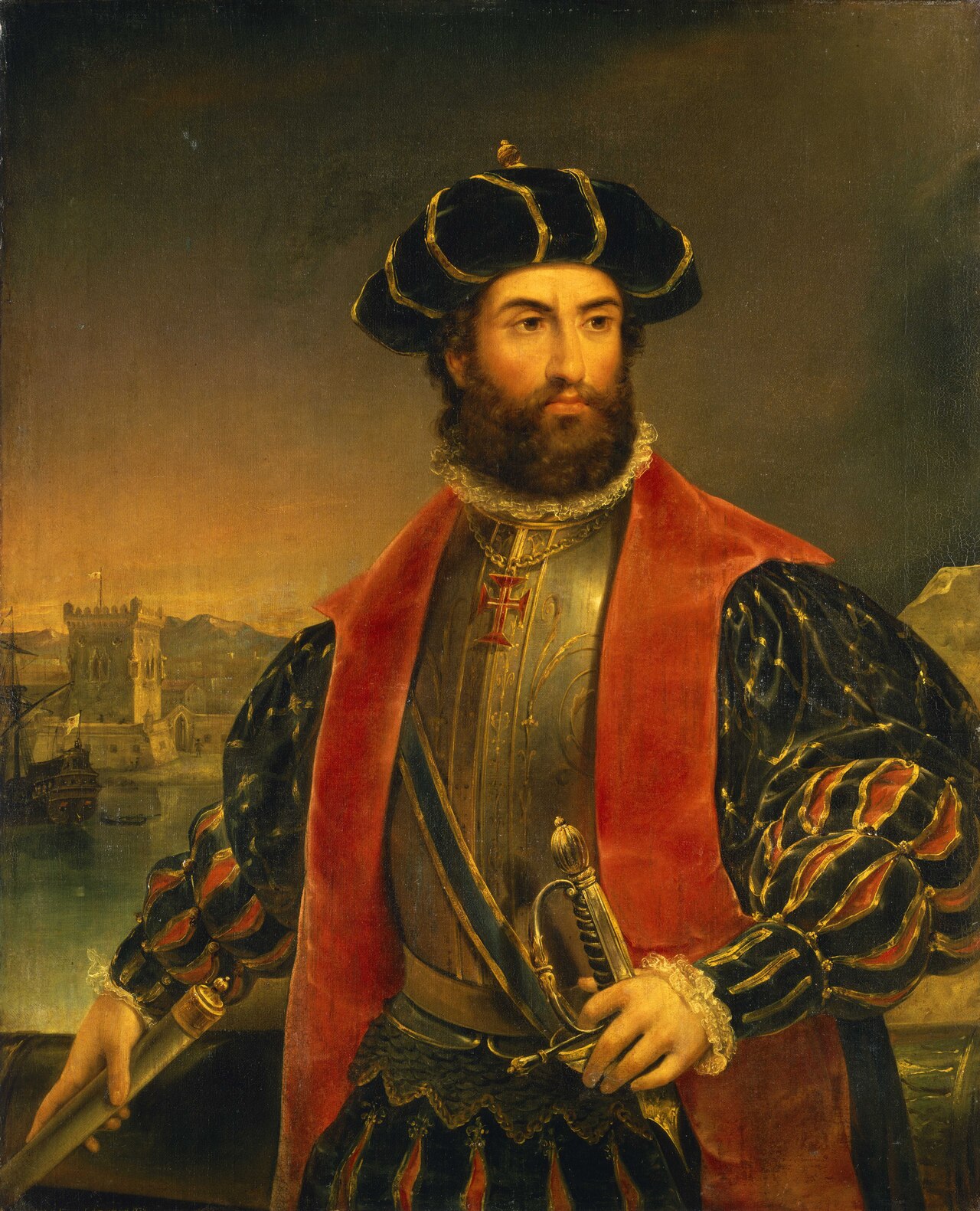
Major works - **Self‑Portrait (1828)** – Executed when Fonseca was in his early thirties, this work presents the artist in a modest studio setting, holding a palette and brush. The portrait demonstrates his command of chiaroscuro, with a softly lit facial expression that conveys both confidence and introspection. The background is rendered with minimal detail, allowing the viewer to focus on the artist’s gaze. - **Dom João VI Rei do Reino Unido de Portugal, Brazil e Algarves, Dedicado ao mesmo Augusto Senhor (1825)** – This official portrait of King João VI was commissioned to commemorate the monarch’s role in the United Kingdom of Portugal, Brazil and the Algarves. Fonseca captures the king in regal attire, surrounded by symbols of empire—scepters, crowns and a maritime globe. The composition balances authority with a subtle humanising touch, evident in the king’s relaxed posture and the soft modelling of his features. - **Vasco da Gama, c.1460‑1524 (1838)** – Celebrating the famed explorer, Fonseca portrays Vasco da Gama in a heroic stance, clutching a navigational instrument. The background suggests a seascape rendered in muted blues, evoking the Age of Discovery. The painting aligns with contemporary nationalist sentiment, presenting da Gama as a timeless embodiment of Portuguese bravery. - **Visitation (1850)** – This religious canvas illustrates the biblical meeting of the Virgin Mary and Saint Elizabeth. Fonseca adopts a calm, reverent atmosphere, with delicate handling of light that bathes the figures in a gentle glow. The work reflects his ability to translate sacred narratives into accessible visual language, employing a restrained colour scheme that underscores the scene’s humility. - **Aeneas Saving His Father Anchises from the Fire of Troy (1855)** – Drawing from Virgil’s *Aeneid*, Fonseca renders a dramatic rescue amid a burning cityscape. The composition is dominated by dynamic diagonal lines, with Aeneas lunging forward while protecting his aged father. The flames are painted with vigorous, impasto strokes, contrasting with the smooth modelling of the protagonists, thereby heightening the emotional intensity of the moment.
These works illustrate Fonseca’s breadth: from portraiture and religious themes to heroic historical episodes. Each piece displays his academic grounding, while also revealing an individual flair for storytelling.
Influence and legacy António Manuel da Fonseca occupied a pivotal position in Portuguese art during the first half of the 19th century. By bridging the classical rigor of the Royal Academy with the emerging Romantic fascination for national myths, he helped shape a visual language that resonated with both elite patrons and the broader public. His theatrical designs influenced stagecraft in Lisbon’s principal theatres, introducing a level of realism that complemented the era’s operatic productions. Though later generations of Portuguese artists gravitated toward Realism and Impressionism, Fonseca’s commitment to narrative clarity and technical precision continued to be cited in art‑historical surveys as a benchmark of academic excellence. Contemporary exhibitions of 19th‑century Portuguese painting frequently include his works, underscoring his enduring relevance as a conduit between Portugal’s historical self‑image and the broader currents of European art.
In scholarly terms, Fonseca is recognised as a key figure who preserved the legacy of the Portuguese Baroque while adapting to the aesthetic currents of his time. His paintings remain valuable primary sources for historians studying visual representations of Portuguese identity, colonial expansion and religious devotion in the 1800s. As such, his oeuvre offers both artistic merit and cultural insight, ensuring that António Manuel da Fonseca retains a respected place in the canon of European art history.
Frequently asked questions
Who was António Manuel da Fonseca?
António Manuel da Fonseca (1796–1890) was a Portuguese painter, illustrator and theatrical designer known for his mythological, historical and religious canvases.
What artistic style or movement is he associated with?
He worked within the academic classicism of the Royal Academy, infused with Romantic narrative drama, but does not belong to a specific later movement.
What are his most famous works?
Key works include the Self‑Portrait (1828), the royal portrait of Dom João VI (1825), Vasco da Gama (1838), the Visitation (1850), and Aeneas saving Anchises (1855).
Why does he matter in art history?
Fonseca helped define 19th‑century Portuguese visual culture, bridging classical training with national Romantic themes and influencing both painting and stage design.
How can I recognise a painting by António Manuel da Fonseca?
Look for careful underdrawings, balanced compositions, warm earth tones, luminous glazing, and a narrative focus that often depicts historic or mythological subjects with dramatic lighting.