Anton Goubau
1616 – 1698
In short
Anton Goubau (1616–1698) was a Flemish Baroque painter from Antwerp who worked in Rome and is best known for his Italianate genre scenes and small‑scale cabinet paintings that echo the Bamboccianti tradition. He combined lively everyday subjects with refined landscape detail, leaving a modest but lasting imprint on Flemish and Italian genre painting.
Notable works


_-_Markt_zwischen_antiken_Ruinen_-_792_-_Staatliche_Kunsthalle_Karlsruhe.jpg)
Early life Anton Goubau was born in Antwerp in 1616, a city that was then part of the Habsburg Netherlands and a thriving centre of artistic production. Little is recorded about his family background, but archival evidence suggests he received his initial training in the workshop of a local master, where he would have learned the fundamentals of drawing, oil technique and the Flemish Baroque idiom that dominated the region. Antwerp’s Guild of Saint Luke, the professional body governing painters, provided a network that later facilitated his departure for Italy, a common pilgrimage for ambitious Northern artists seeking classical inspiration and patronage.
Career and style Around the early 1640s Goubau travelled to Rome, the cosmopolitan hub for artists from across Europe. In the Eternal City he entered the circle of the Bamboccianti, a loosely organised group of mainly Dutch and Flemish painters who specialised in small‑scale, realist genre scenes of everyday life, especially the lower‑class activities in the Roman streets and countryside. The Bamboccianti were noted for their unidealised subjects, keen observation, and a palette that captured the warm Mediterranean light.
Goubau’s work reflects this milieu but also demonstrates a personal synthesis of Flemish detail with Italianate atmosphere. He produced both genre scenes and more formal history paintings, often integrating mythological or religious narratives into bustling market or pastoral settings. His canvases are characterised by careful compositional balance, a muted yet luminous colour scheme, and a subtle narrative quality that invites the viewer to linger on the interactions of figures within a broader landscape.
Signature techniques Goubau favoured a compact format, typically producing cabinet paintings no larger than 30 × 40 cm, a size that suited private collectors and decorative interiors. He employed a layered glazing technique, applying thin translucent layers of oil over an underpainting to achieve depth and a soft glow reminiscent of the Italian golden hour. His brushwork varies between fine, almost stippled detailing in foliage and architecture, and broader, more gestural strokes for figures, allowing a contrast between the solidity of structures and the movement of people.
Light plays a central role in his compositions; he often positioned the sun low in the sky, casting long shadows that accentuate the three‑dimensionality of arches, columns and market stalls. Atmospheric perspective is achieved through progressive desaturation and a hazy blue‑green veil on distant elements, a method that underscores the expansive Roman landscape beyond the immediate scene.
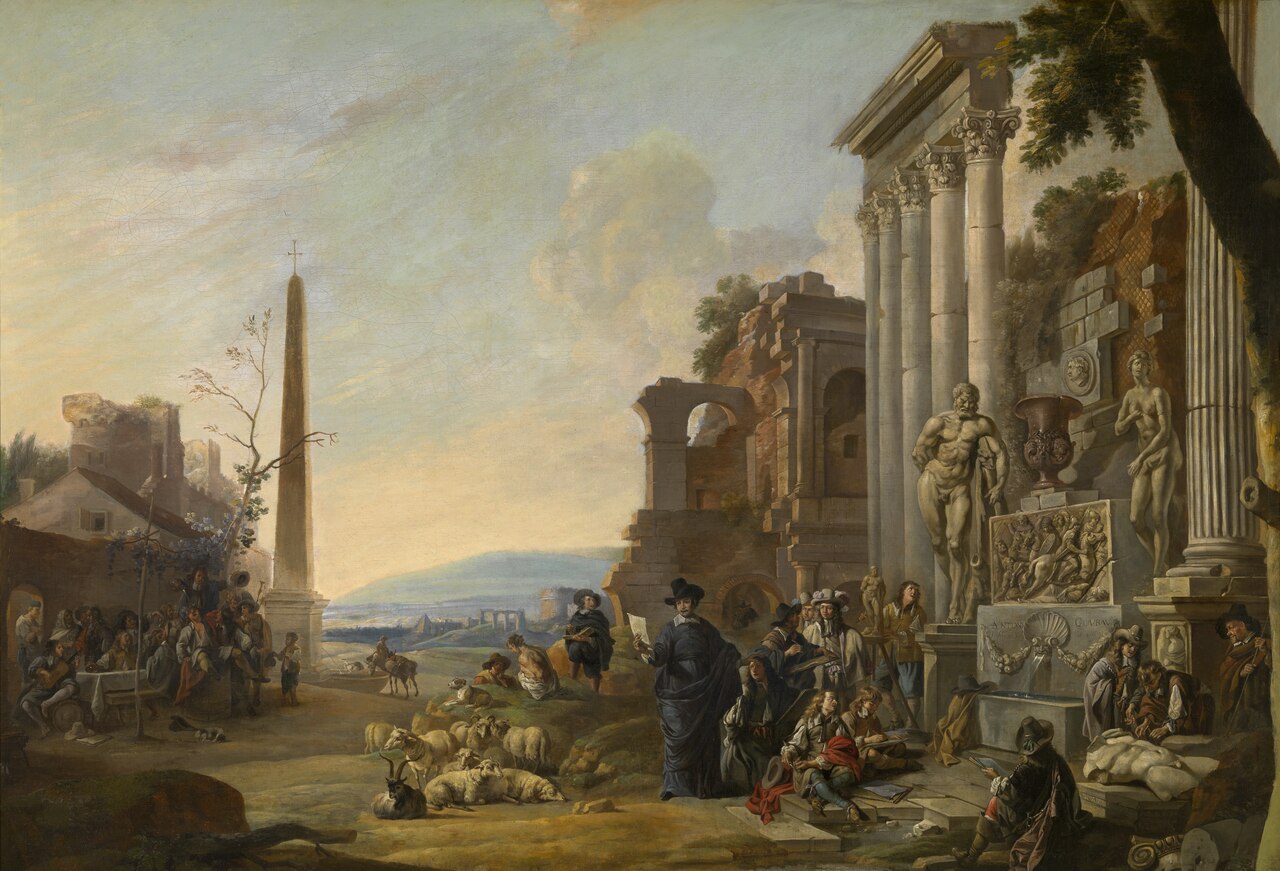
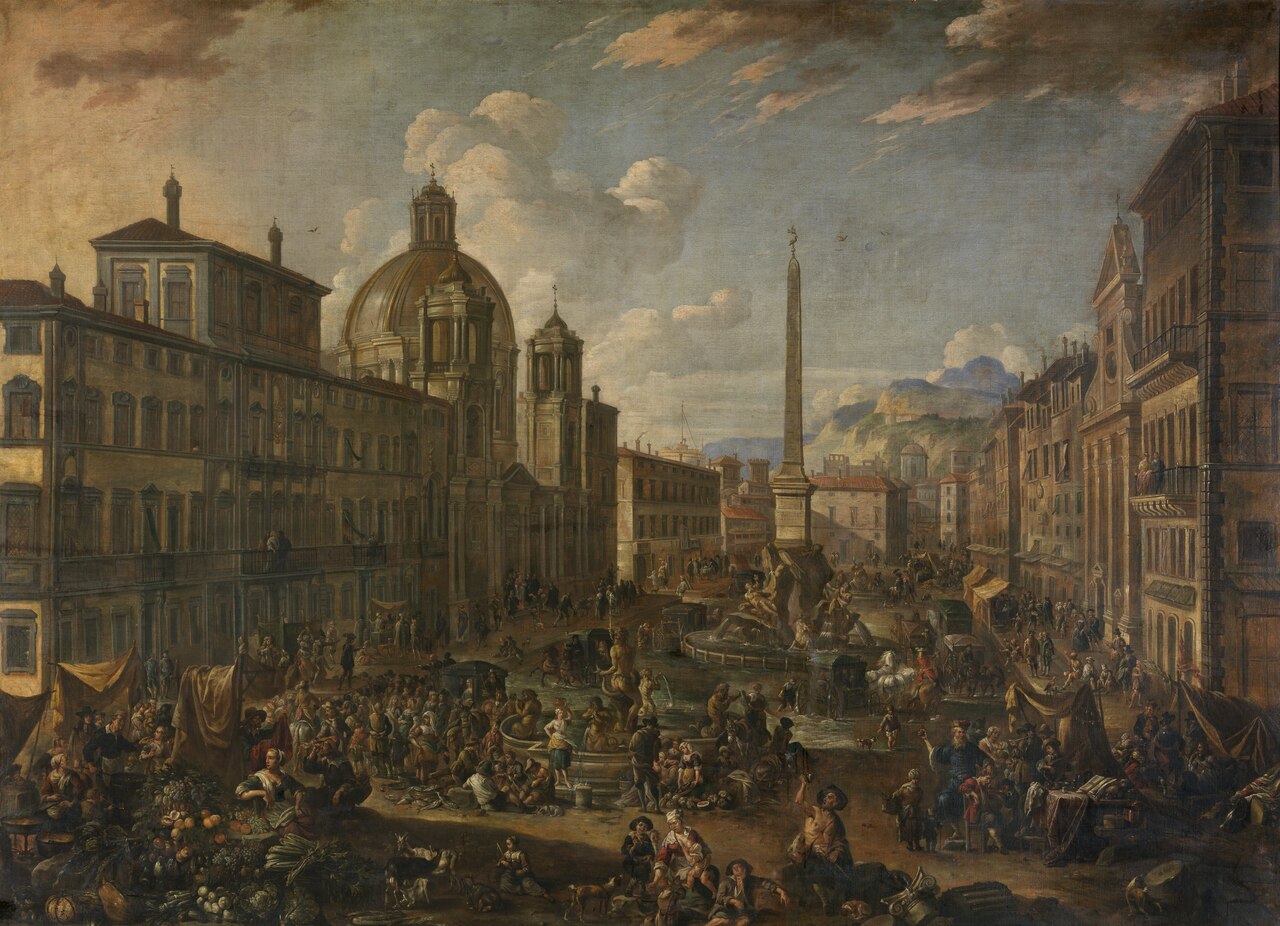
Major works - **The Study of Art in Rome (1662)** – This work depicts a group of artists gathered around a sketchbook in a Roman courtyard, illustrating Goubau’s awareness of the collaborative spirit among Northern painters in Italy. The composition balances the interior architectural framing with a sunlit background, highlighting his skill at integrating human activity with built space. - **Concert (1648)** – One of his earlier dated pieces, it shows musicians performing in an open-air setting, possibly a garden or a rustic tavern. The scene captures a convivial atmosphere, with careful attention to the texture of clothing and the interplay of light on strings and woodwinds. - **Piazza Navona in Rome (1680)** – In this later landscape, Goubau renders the bustling piazza with its iconic fountains and surrounding palazzi. The painting demonstrates his mature handling of perspective, as the converging lines of the square draw the eye toward the central obelisk, while lively figures animate the scene. - **A Farmyard** – Though undated, this composition reflects his continued interest in rural subjects. A modest farmhouse, livestock, and peasants at work are presented with a warm tonal harmony, emphasizing the harmony between human labour and the natural environment. - **Market between ancient ruins (1658)** – This painting juxtaposes a vibrant market scene against the backdrop of crumbling Roman ruins, a motif that underscores the dialogue between contemporary commerce and the legacy of antiquity. The work is notable for its precise rendering of stone textures and the subtle narrative suggestion that the ancient past frames present activity.
Influence and legacy Anton Goubau never achieved the fame of contemporaries such as Rubens or Van Dyck, yet his oeuvre provides valuable insight into the cross‑cultural exchange between the Flemish Baroque tradition and the Roman genre painters of the mid‑17th century. His paintings were collected by private patrons in both the Low Countries and Italy, and they circulated through the networks of art dealers that linked Antwerp with Rome. The modest size of his works made them suitable for domestic display, influencing later Flemish artists who sought to cater to the growing market for intimate, narrative pieces.
Art historians recognise Goubau as a bridge figure: his disciplined Flemish technique combined with the naturalistic observation of the Bamboccianti contributed to the development of a more nuanced genre painting in Northern Europe. Subsequent generations of Dutch and Flemish painters, such as Pieter van Lint and Jan Baptist van der Meulen, inherited his approach to light, atmospheric depth, and the integration of everyday life with classical settings. Though his name is not as widely known as some of his peers, Goubau’s paintings remain in the collections of several European museums, where they continue to inform studies of Baroque genre painting and the cultural interchange that defined the artistic landscape of 17th‑century Europe.
Frequently asked questions
Who was Anton Goubau?
Anton Goubau was a Flemish Baroque painter (1616–1698) from Antwerp who spent much of his career in Rome, creating genre scenes and Italianate landscapes in the style of the Bamboccianti.
What artistic movement or style is he associated with?
He is linked to the Bamboccianti tradition of small‑scale, realist genre painting, blending Flemish detail with the warm light and architectural settings of Italian Baroque.
What are his most famous works?
Key works include *The Study of Art in Rome* (1662), *Concert* (1648), *Piazza Navona in Rome* (1680), *A Farmyard*, and *Market between ancient ruins* (1658).
Why is Anton Goubau important in art history?
He exemplifies the cultural exchange between Northern Europe and Italy in the 17th century, influencing later Flemish and Dutch genre painters with his nuanced handling of light, perspective, and everyday subjects.
How can I recognise an Anton Goubau painting?
Look for compact cabinet‑size canvases, a warm Mediterranean light, meticulous detail in architecture and foliage, and lively figures set within Italian cityscapes or rural scenes.