Aniello Falcone
1607 – 1656
In short
Aniello Falcone (1607–1656) was a Neapolitan Baroque painter renowned for his vivid battle scenes, making him one of the earliest specialists in military genre painting in Italy.
Notable works
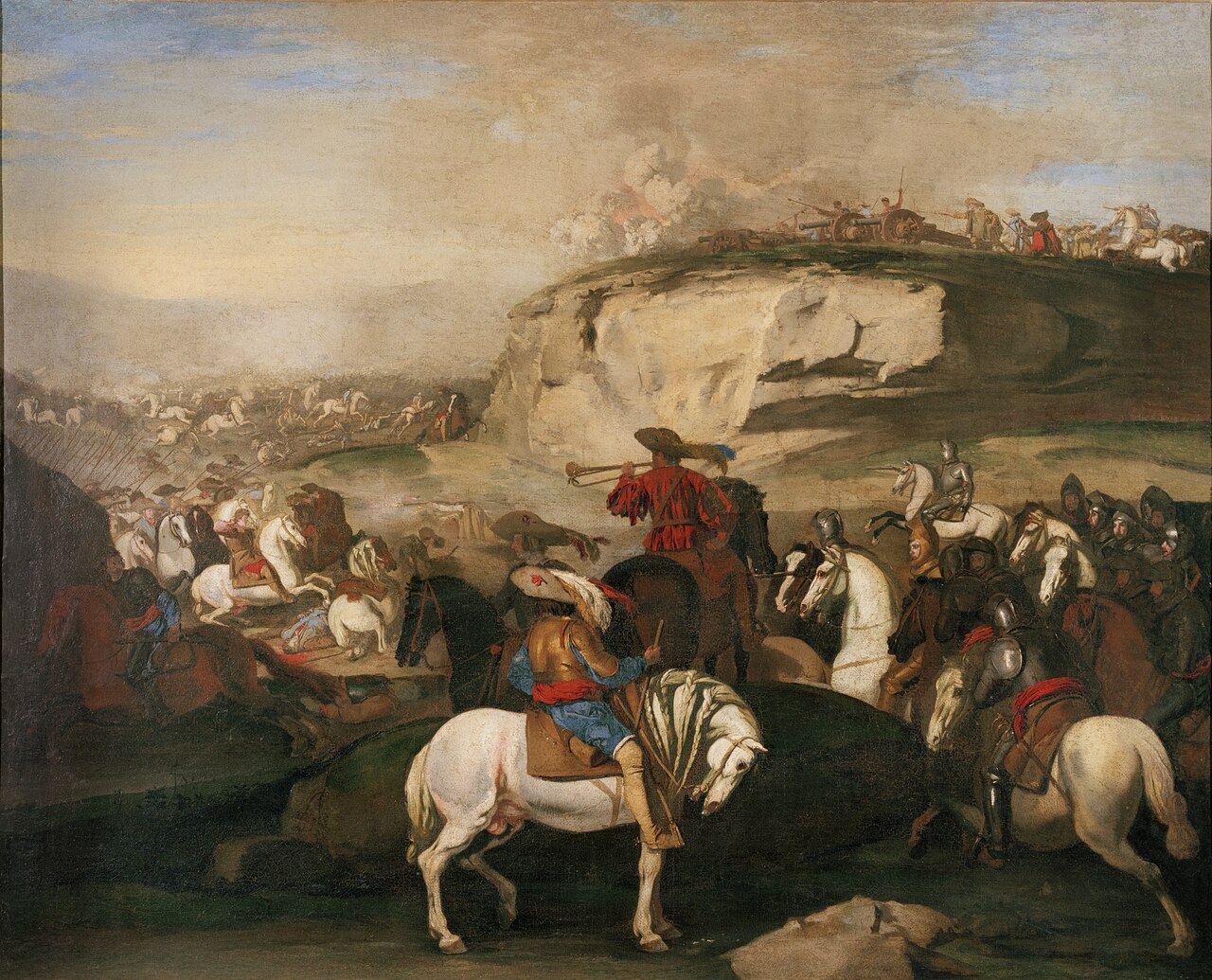


Early life Aniello Falcone was born in 1607 in Naples, a bustling port city that was then part of the Kingdom of Naples. Little is recorded about his family background, but it is clear that he grew up in an environment steeped in artistic activity. Naples in the early seventeenth century was a melting‑pot of artistic influences, from the dramatic naturalism of Caravaggio’s followers to the decorative exuberance of the local workshop tradition. Falcone likely received his first training in a local workshop, where he would have been introduced to the techniques of oil painting, drawing from life, and the emerging Baroque vocabulary of dynamic movement and chiaroscuro.
Career and style Falcone’s career unfolded against the backdrop of a city that, after the 1647 revolt, experienced a surge in commissions for public and private works. He quickly distinguished himself by focusing on a subject that had been relatively neglected by his contemporaries: the battlefield. While many Neapolitan painters favoured religious narratives or mythological scenes, Falcone turned his attention to the drama of war, capturing the chaos, the clash of arms, and the human emotions that accompany combat.
His style is firmly rooted in the Baroque tradition, characterised by vigorous compositions, dramatic lighting, and a keen interest in narrative immediacy. He absorbed the tenebrism of Caravaggio’s circle, employing strong contrasts of light and dark to model figures and to highlight moments of tension. At the same time, he incorporated the colouristic richness typical of Neapolitan painters such as Luca Giordano, creating a palette that could shift from the deep reds of blood‑stained armour to the luminous blues of the sky. Falcone’s work often balances a realistic observation of military equipment—swords, pikes, helmets—with a theatrical staging that elevates the scene beyond mere reportage.
Signature techniques Falcone developed several technical hallmarks that help to identify his hand:
1. Layered chiaroscuro – He would lay down a dark underpainting, then build up highlights in successive glazes, allowing the light to emerge gradually and giving his figures a three‑dimensional solidity. 2. Dynamic diagonal composition – Battle scenes frequently feature strong diagonal lines that guide the viewer’s eye across the canvas, creating a sense of motion and tension. 3. Textural detail in armour and weaponry – Falcone rendered metal surfaces with meticulous brushwork, often using a fine, stippled technique to suggest reflected light and the wear of battle. 4. Crowd management – In large groups he employed a hierarchical arrangement: the most important figures are rendered with greater clarity and colour, while peripheral combatants dissolve into a more muted background, maintaining narrative focus. 5. Use of atmospheric effects – Smoke, dust, and distant landscape elements are suggested with soft, almost impressionistic strokes, providing depth and a sense of the larger battlefield.
These techniques combine to produce works that are both historically informative and emotionally resonant.
Major works Falcone’s surviving oeuvre, though limited, offers a clear view of his thematic preoccupations.
- Battle Scene (1634) – This early work demonstrates Falcone’s mastery of compositional drama. A chaotic melee unfolds under a stormy sky, with cavalry charges intersecting infantry lines. The painting’s use of chiaroscuro heightens the sense of danger, while the detailed rendering of armour showcases Falcone’s technical skill.
- Roman Soldiers in the Circus (1640) – Though the subject shifts from battlefield to arena, the painting retains the same energetic rhythm. Roman legionaries are depicted in a spectacle setting, their disciplined formations contrasted with the uncontrolled crowd. Falcone’s handling of crowd dynamics here foreshadows later Baroque crowd scenes.
- The Concert (1640) – A departure from his martial subjects, this work reveals Falcone’s versatility. Musicians gather in an intimate interior, illuminated by a warm, golden light. The soft modelling of faces and the careful rendering of musical instruments suggest that Falcone was equally comfortable with genre scenes.
- Roman Athletes (1640) – In this composition, Falcone returns to classical themes, portraying muscular athletes preparing for competition. The anatomical precision and the tension in the figures echo his battle studies, indicating a consistent interest in the human body under strain.
- Casting the Money Changers out of the Temple (1630) – This religious narrative, commissioned for a Neapolitan church, displays Falcone’s ability to translate his dramatic flair to sacred subjects. The forceful gestures of the apostles and the chaotic scattering of the money changers echo the kinetic energy seen in his later battle paintings.
Together, these works illustrate Falcone’s range—from martial spectacle to intimate genre scenes—while maintaining a distinctive visual language.
Influence and legacy Aniello Falcone is often credited as one of the first painters to specialise in military subjects in Italy. His focus on battle scenes paved the way for later artists such as Salvator Rosa, who would expand the genre to include more romanticised and mythic battles. Falcone’s approach to crowd composition and his skillful handling of light influenced a generation of Neapolitan painters who sought to capture drama on a large scale.
Beyond stylistic influence, Falcone played a role in the cultural identity of Naples. By depicting the city’s own military engagements—particularly the conflicts surrounding the 1647 revolt—he contributed to a visual record of contemporary events, offering future historians a glimpse of seventeenth‑century warfare.
In modern scholarship, Falcone is recognised not only for his artistic achievements but also for his contribution to the development of genre painting in the Baroque period. His works continue to be exhibited in major Italian museums, and they are frequently cited in discussions of early modern depictions of combat. Though his name may not be as widely known as Caravaggio or Bernini, Falcone’s legacy endures in the way he fused narrative intensity with technical mastery, establishing a visual language that resonated throughout the Baroque era.
Frequently asked questions
Who was Aniello Falcone?
Aniello Falcone (1607–1656) was a Neapolitan Baroque painter best known for pioneering the genre of battle scene painting in Italy.
What style or movement is Falcone associated with?
He worked within the Baroque tradition, employing dramatic lighting, dynamic composition, and a vivid colour palette.
What are Falcone's most famous works?
Key works include *Battle Scene* (1634), *Roman Soldiers in the Circus* (1640), *The Concert* (1640), *Roman Athletes* (1640) and *Casting the Money Changers out of the Temple* (1630).
Why does Falcone matter in art history?
Falcone is significant for being one of the first artists to specialise in military subjects, influencing later Baroque painters and providing a visual record of 17th‑century warfare.
How can I recognise a Falcone painting?
Look for vigorous diagonal compositions, strong chiaroscuro, detailed armour and weaponry, and a lively crowd where the main figures are rendered with crisp detail against a more muted background.