Andrea Schiavone
1510 – 1563
In short
Andrea Schiavone (1510–1563) was a Dalmatian-born painter and etcher who worked mainly in Venice. He blended Venetian colouristic traditions with emerging Mannerist gestures, creating a distinctive style that influenced later Venetian artists.
Notable works

_(attributed_to)_-_Arcas_Hunting_-_NG1883_-_National_Gallery.jpg)
_(attributed_to)_-_Jupiter_seducing_Callisto_-_NG1884_-_National_Gallery.jpg)

Early life Andrea Schiavone, also recorded as Andrea Meldolla, was born in 1510 in Zadar, a coastal town on the Dalmatian coast that belonged to the Republic of Venice. His family had roots in Emilia‑Romagna, but the young Andrea grew up in a multicultural environment where the Slavic, Italian and Venetian cultures intersected. Little is known about his formal training, but the artistic climate of Zadar—exposed to both local Byzantine influences and the flourishing Venetian art market—provided a fertile ground for his early development. By his late teens he had moved to Venice, the centre of Renaissance painting, where he would spend the majority of his professional life.
Career and style In Venice Schiavone entered a bustling workshop scene dominated by Titian, Veronese and the younger generation of Mannerists. He quickly distinguished himself by absorbing the rich colour and atmospheric effects championed by Titian while also experimenting with the elongated forms, complex poses and heightened emotional expression that characterised Mannerism. This hybrid approach was relatively rare in the Venetian context, where the dominant aesthetic prized naturalistic colour over the stylised elegance of the courtly style. Schiavone’s paintings therefore occupy a transitional space: they retain the luminous, sensuous palette of the Venetian school yet display a more dynamic composition and a willingness to bend anatomical conventions.
Throughout the 1540s and 1550s he received commissions for both private devotional works and mythological scenes, often for aristocratic patrons who admired the novelty of his synthesis. He also produced a substantial body of etchings, disseminating his designs beyond Venice and influencing print‑makers throughout Italy. His career was marked by a steady output rather than a single breakthrough; he remained a respected, if not headline‑grabbing, figure within the Venetian artistic community until his death in 1563.
Signature techniques Schiavone’s technique is identifiable through several recurring elements. First, his handling of oil paint features a semi‑transparent layering that creates depth without the heavy glazes favoured by his contemporaries. This approach allows subtle shifts in tone, particularly in flesh and sky, giving his figures a soft, almost ethereal presence. Second, his compositional arrangements often employ diagonal thrusts and compressed spatial zones, a hallmark of Mannerist drama that contrasts with the more balanced, pyramidal structures of High Renaissance works. Third, his etchings reveal a deft use of line—both fine hatching for delicate shadows and bold, sweeping strokes for muscular contours—demonstrating a mastery of print technique that complements his painted oeuvre. Finally, his colour palette frequently juxtaposes warm ochres and reds with cooler blues and greens, a chiaroscuro that heightens the emotional intensity of his narratives.
Major works Among Schiavone’s extant paintings, several stand out for their thematic variety and technical mastery. *The Marriage of Cupid and Psyche* (c. 1550) illustrates his skill in rendering mythological romance; the composition balances an intimate foreground with a luminous, cloud‑filled background, while the figures display the elongated elegance typical of Mannerist influence. *Arcas Hunting* (c. 1550) showcases his ability to depict movement, as the hunter and his hounds are caught mid‑pursuit against a rugged landscape rendered in muted earth tones. *Jupiter Seducing Callisto* (c. 1550) is another mythological scene where Schiavone employs dramatic lighting to emphasise the tension between the divine and the mortal. *Aeneas Takes Leave of Dido* (c. 1555) reflects his narrative skill, capturing the poignant farewell through careful gesture and a restrained colour scheme that underscores the emotional weight of the moment.
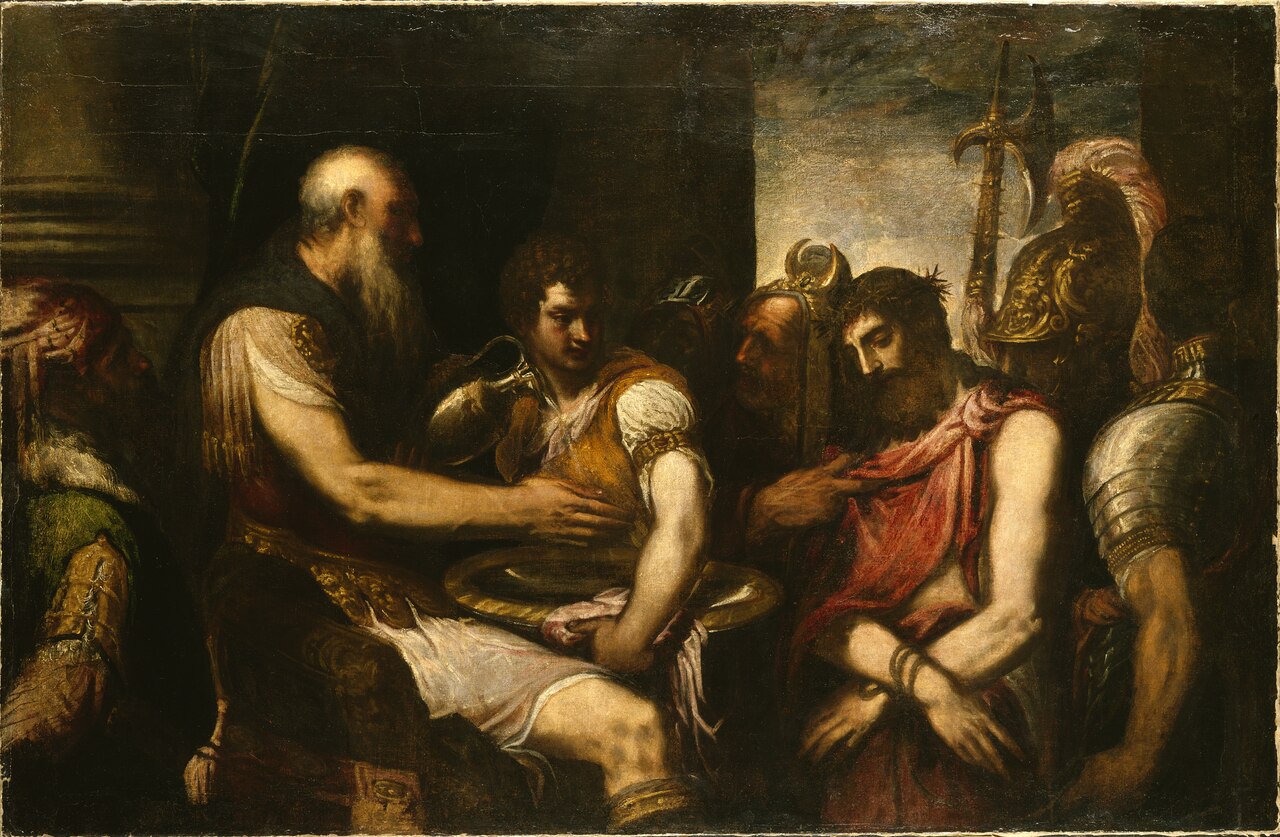
A work attributed to him, *Christ before Pilate*, bears a later date (c. 1600) that post‑dates Schiavone’s death. Scholars generally regard this painting as a misattribution or a later copy based on his designs, rather than an authentic autograph work. Its inclusion in the catalogue of his works therefore serves as a reminder of the uncertainties that sometimes surround provenance in Renaissance art.
Influence and legacy Andrea Schiavone’s legacy lies in his role as a conduit between the colour‑rich Venetian tradition and the more stylised, expressive language of Mannerism. By integrating these strands, he offered a model for later Venetian painters who sought to expand the emotional range of their canvases without abandoning the sumptuous tonal qualities that defined the school. His etchings, circulated widely, contributed to the diffusion of his compositional ideas across Italy, influencing artists such as Federico Zuccari and later Baroque practitioners who admired his fluid line work.
Although he never achieved the fame of Titian, Schiavone’s work remains a valuable reference point for scholars studying the cross‑currents of 16th‑century Italian art. Contemporary exhibitions often pair his paintings with those of his Venetian peers to highlight the nuanced dialogue between naturalistic colour and Mannerist form. In this way, Andrea Schiavone continues to be recognised as a pivotal, though understated, figure who helped shape the evolution of Venetian painting in the decades leading up to the Baroque.
Frequently asked questions
Who was Andrea Schiavone?
Andrea Schiavone (1510–1563) was a Dalmatian‑born painter and etcher who worked mainly in Venice, known for blending Venetian colourism with Mannerist stylistic elements.
What artistic style or movement is he associated with?
He is best described as a Venetian Mannerist, merging the rich palette of the Venetian school with the elongated forms and dynamic compositions typical of Mannerism.
What are his most famous works?
Key works include *The Marriage of Cupid and Psyche* (c. 1550), *Arcas Hunting* (c. 1550), *Jupiter Seducing Callisto* (c. 1550) and *Aeneas Takes Leave of Dido* (c. 1555).
Why is Andrea Schiavone important in art history?
He provided a bridge between Venetian colouristic tradition and the emerging Mannerist aesthetic, influencing later Venetian painters and spreading his designs through widely circulated etchings.
How can I recognise a painting by Schiavone?
Look for semi‑transparent oil layers, a warm‑cool colour juxtaposition, diagonal compositional thrusts, and elongated, expressive figures that combine Venetian softness with Mannerist drama.