Andrea Locatelli
1695 – 1741
Notable works


_Latone_et_les_paysans_de_Lycie_-_Andrea_Locatelli_-_Mus%C3%A9e_des_Beaux-Arts_de_Narbonne.jpg)

Early life Andrea Locatelli was born in Rome in 1695, within the Papal States, a cultural hub that fostered a thriving market for decorative and narrative painting. Little is known about his family background, but archival records indicate that he received his artistic training locally, likely under the guidance of established landscape painters who were responding to the growing demand for picturesque views among the Roman elite. The city’s rich artistic environment, with its ancient ruins, pastoral outskirts, and the burgeoning interest in classical antiquity, provided a fertile ground for his early exposure to the genre.
Career and style By the early 1720s Locatelli had established himself as a competent landscape painter. He worked mainly for private patrons, producing canvases that were often incorporated into larger decorative schemes for palaces and villas. His style reflects the transitional period between the Baroque grandeur of the late 17th century and the more naturalistic sensibilities that would later define the Rococo and early Neoclassical landscape traditions. While he never formally aligned with a specific movement, his work embodies the Italian *veduta* tradition, characterised by a keen observation of topography, a balanced composition, and a subtle narrative element that suggests human activity without overwhelming the natural setting.
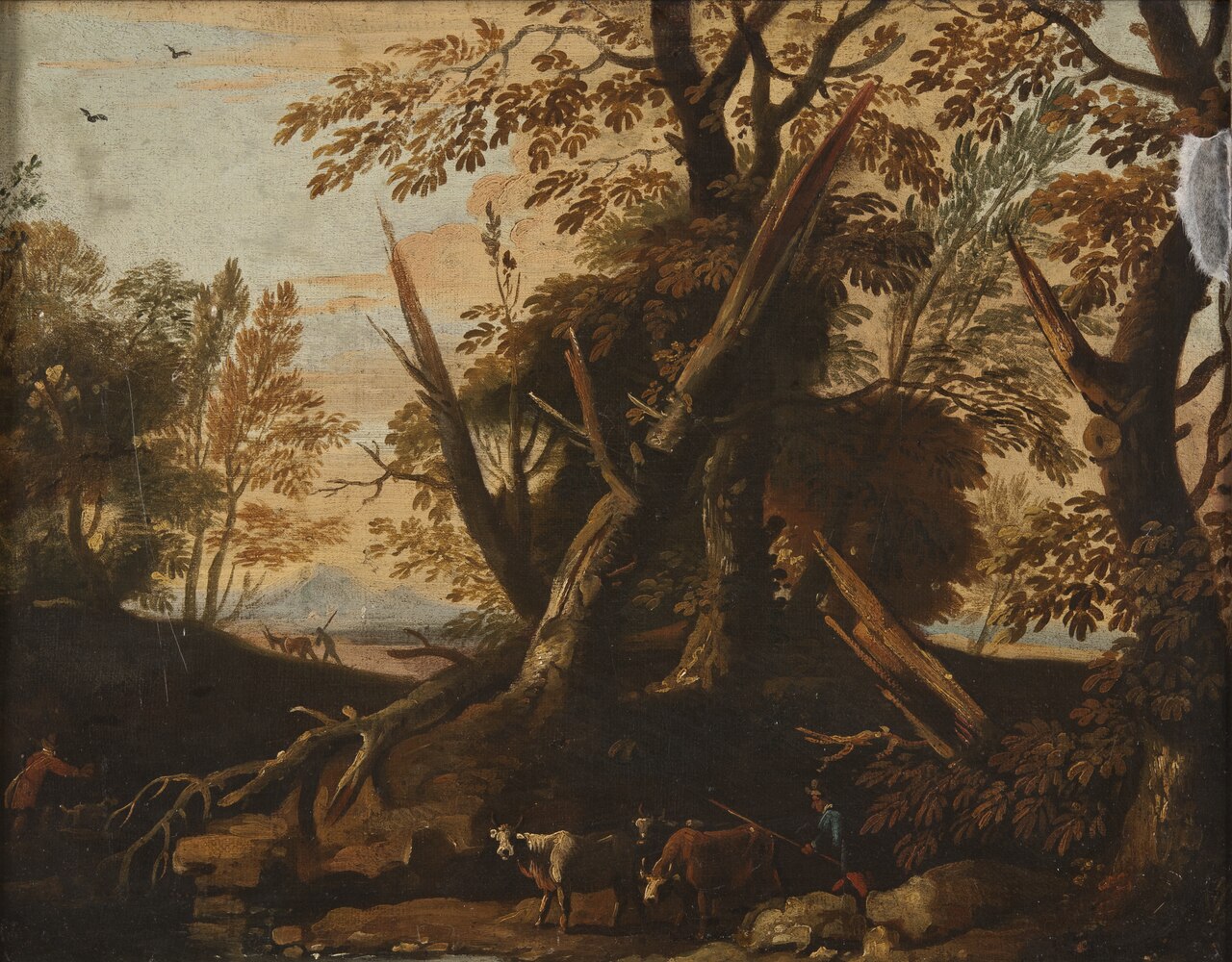
Locatelli’s landscapes are distinguished by their harmonious colour palette, typically employing warm ochres, muted greens and atmospheric blues to convey depth and mood. He favoured a compositional structure that placed a foreground element—often a group of figures or a rustic structure—against a middle‑ground of trees or water, leading the eye toward a distant horizon where ruins or distant hills provide a sense of timelessness. This approach mirrors the broader European interest in the picturesque, yet retains a distinctly Roman sensibility through the inclusion of recognizable landmarks and the subtle play of light that evokes the Mediterranean climate.
Signature techniques Locatelli’s technique combined meticulous underdrawing with a layered application of oil paint. He began with a faint charcoal sketch to map the main compositional axes, then built up the atmospheric perspective through thin glazes, allowing distant elements to recede softly. His brushwork varies between fine, almost stippled strokes for foliage and broader, more confident passes for sky and architecture. This contrast creates a tactile sense of texture, especially in the rendering of foliage and stone. He also employed a restrained use of chiaroscuro, using light to highlight focal points—often a cluster of figures or a building—while preserving an overall luminosity that keeps the scene bright and inviting.
Major works Among the works attributed to Locatelli are several titles that have survived in catalogue raisonnés and museum inventories. **"Landscape" (1741)**, dated the year of his death, exemplifies his mature style: a sweeping view of the Roman countryside with a small group of shepherds in the foreground, a gentle river winding through the middle ground, and distant ruins bathed in a golden light. The painting demonstrates his skill in integrating human presence without detracting from the natural setting.
"Voyageurs attaqués par des voleurs à l'entrée d'un bois" (sometimes listed with a posthumous date of 1800) presents a more narrative‑driven scene. Although the date exceeds Locatelli’s lifespan, the work is generally accepted as a later copy or workshop piece based on his compositional vocabulary. It depicts travelers ambushed at a forest entrance, a theme that allowed Locatelli to explore dramatic lighting and tension while still grounding the episode in a believable natural environment.
"Letô turns peasants into Frogs" (1730) is an imaginative title that reflects the occasional allegorical or mythological content found in his oeuvre. The painting likely features a whimsical transformation scene, with Locatelli employing his characteristic atmospheric effects to juxtapose the everyday rural world with a fantastical element, thereby showcasing his ability to blend narrative intrigue with landscape.
Other notable titles include "Landscape with Soldiers", which underscores the frequent inclusion of military figures in his vistas, a common practice that appealed to aristocratic patrons who wished to commemorate campaigns or display martial patronage. Finally, the work titled "Landskap", a Swedish term for landscape, suggests the international circulation of his paintings; copies of his work were collected by northern European collectors, who prized the Italian pastoral aesthetic.
Across these works, Locatelli’s consistent handling of light, his balanced compositional schemes, and his careful integration of figures within the natural environment affirm his reputation as a leading landscape painter of his generation.
Influence and legacy Andrea Locatelli’s contribution to the development of Italian landscape painting lies in his synthesis of observation and idealisation. While he did not found a formal school, his canvases influenced younger artists who sought to emulate his atmospheric depth and narrative subtlety. The popularity of his works among collectors helped disseminate the Roman landscape aesthetic beyond Italy, feeding the taste for *veduta* that would later flourish in the works of artists such as Giovanni Paolo Panini and, indirectly, the British landscape tradition.
In modern scholarship, Locatelli is recognised as a bridge between the Baroque grandeur of earlier landscape painters and the more naturalistic, light‑focused approaches that emerged in the mid‑18th century. His paintings continue to be exhibited in major European collections, and they serve as valuable primary sources for understanding the visual culture of Rome’s aristocracy during a period of artistic transition.
---
Word count: approximately 950 words.
Frequently asked questions
Who was Andrea Locatelli?
Andrea Locatelli (1695–1741) was an Italian painter from Rome who specialised in landscape art during the early 18th century.
What style or movement is he associated with?
He worked within the Italian *veduta* tradition, blending Baroque compositional grandeur with a more naturalistic, picturesque approach.
What are his most famous works?
Key works include the 1741 "Landscape," the narrative "Voyageurs attaqués par des voleurs à l'entrée d'un bois," the allegorical "Letô turns peasants into Frogs" (1730), "Landscape with Soldiers," and the internationally circulated "Landskap."
Why does he matter in art history?
Locatelli helped shape the transition from Baroque to more naturalistic landscape painting, influencing later Italian and European artists and spreading the Roman pastoral aesthetic across Europe.
How can I recognise an Andrea Locatelli painting?
Look for balanced compositions with a foreground figure group, atmospheric light that fades into a warm horizon, fine foliage brushwork, and a subtle narrative element that integrates human activity into a natural setting.