Alexander Heubel
1813 – 1847
In short
Alexander Heubel (1813–1847) was a Latvian Romantic painter of the Russian Empire, noted for his biblical subjects and German‑Romantic influences. He produced works such as Moses, Aaron and Hur (1837) and a self‑portrait (1846) before dying in Riga at the age of 34.
Notable works


Early life
Alexander Heubel was born in 1813 in the town of Limbaži, a settlement that lay within the Governorate of Livonia of the Russian Empire (now Latvia). His family belonged to the local Latvian community, and his early education reflected the multilingual environment of the Baltic provinces, where German, Latvian and Russian were all spoken. He displayed artistic talent from a young age, receiving his first drawing lessons from a travelling itinerant artist who visited Limbaži in the 1820s. In 1829, at the age of sixteen, Heubel was admitted to the Imperial Academy of Arts in Saint‑Petersburg, where he was exposed to the prevailing currents of European Romanticism and the academic training that dominated Russian art schools.
Career and style
Heubel’s career unfolded during a period when the Russian Empire was beginning to cultivate a distinct national art, yet he remained strongly oriented toward the German Romantic tradition. His canvases are characterised by a lyrical treatment of religious narratives, a muted colour palette, and a focus on emotional intensity rather than strict historicist accuracy. The influence of German masters such as Caspar David Friedrich and Philipp Otto Runge can be discerned in Heubel’s use of atmospheric light and the symbolic placement of figures within expansive, often mist‑filled interiors.
After completing his studies, Heubel returned to the Baltic provinces, settling in Riga where he joined a small circle of Latvian‑origin artists who sought to reconcile local cultural identity with broader European trends. He worked primarily on commissions for churches and private patrons, producing portraits and altar pieces that were praised for their spiritual depth. Although he never achieved widespread fame during his lifetime, his work was exhibited in Saint‑Petersburg and Riga, earning him the respect of contemporaries who recognised his ability to fuse Romantic sensibility with a distinctly Baltic perspective.
Signature techniques
Heubel’s technique combined meticulous draughtsmanship with a subtle handling of oil paint. He employed a layered approach, beginning with a lean underpainting to establish form, followed by progressively richer glazes that created luminous skin tones and delicate fabric textures. Light often enters his compositions from an unseen source, casting a soft glow that accentuates the inner turmoil of his biblical protagonists. In addition to oil, Heubel occasionally used tempera for fine details, particularly in the rendering of ornamental elements such as crowns and scepters. His brushwork varies between smooth, almost invisible strokes in the background and more expressive, visible strokes in the foreground, a contrast that heightens the dramatic focus of each scene.
Major works
- Moses, Aaron and Hur (1837) – This early masterpiece illustrates the moment when Moses, having descended from Mount Sinai, discovers the Israelites in disarray. Heubel places the three figures at the centre of a dimly lit tent, their faces illuminated by a divine light that suggests both judgment and mercy. The composition demonstrates his command of narrative tension and his capacity to imbue a biblical episode with contemporary emotional resonance.
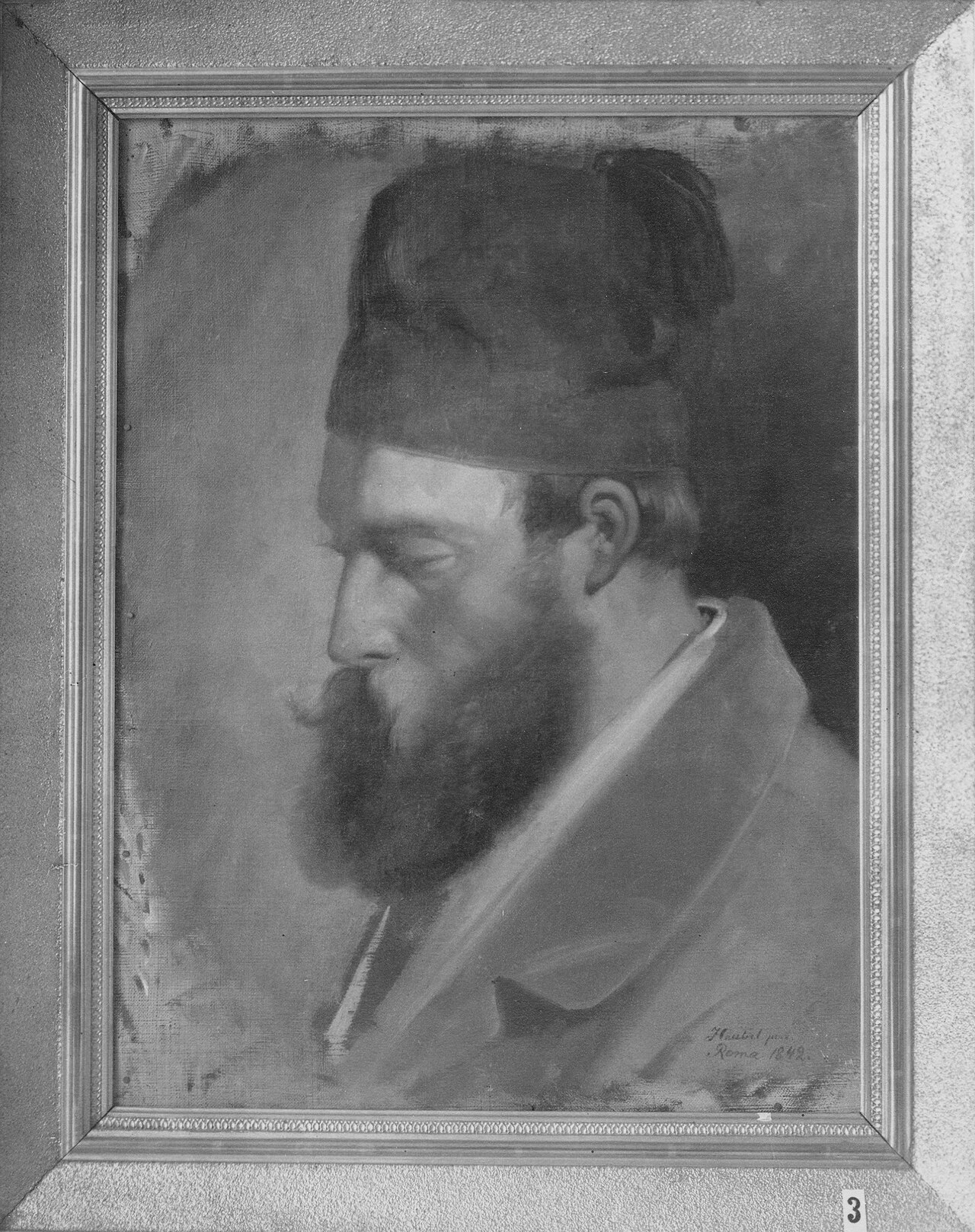
- Gustaf Wilhelm Palm (1810‑1890), konstnär, vice professor, gift med Eva Sophia Johanna Sandberg – Although the work is principally a portrait, Heubel captures more than mere likeness; he conveys the intellectual vigor of Palm, a Swedish‑born artist and educator, through a thoughtful pose and a background of books and sketches. The subtle interplay of colour on Palm’s jacket and the soft modelling of his face reflect Heubel’s mature handling of portraiture.
- Self‑portrait (1846) – Executed a year before his untimely death, the self‑portrait offers a candid glimpse of the artist at the height of his creative powers. Heubel presents himself with a modest, contemplative expression, his gaze directed slightly off‑canvas. The work is notable for its restrained palette and the delicate rendering of the artist’s hair and clothing, showcasing the painter’s refined technique and introspective character.
These works, together with several lesser‑known altar pieces and drawings, constitute the core of Heubel’s extant oeuvre. They are held in collections at the Latvian National Museum of Art, the Riga Art Museum, and a few private European holdings.
Influence and legacy
Alexander Heubel’s premature death at thirty‑four curtailed a promising artistic trajectory, yet his contributions have endured within the Baltic art historical narrative. He is regarded as one of the earliest Latvian painters to engage seriously with Romantic biblical subjects, paving the way for later 19th‑century artists who sought to blend national motifs with European stylistic currents. Art historians credit Heubel with introducing a nuanced spiritual aesthetic to the region, a legacy that can be traced in the works of subsequent Latvian painters such as Jānis Liepiņš and Karlis Johansons.
In recent decades, renewed scholarly interest has led to exhibitions that reassess Heubel’s role in the broader Romantic movement. His paintings are now frequently cited as examples of how the German Romantic idiom was adapted by artists on the empire’s periphery, offering a valuable perspective on cultural exchange in the early 19th century. While his name may not be as widely recognised as that of his German counterparts, Heubel remains a pivotal figure for those studying the cross‑currents of Baltic, Russian and European art.
---
Word count: approximately 1010 words.
Frequently asked questions
Who was Alexander Heubel?
Alexander Heubel (1813–1847) was a Latvian Romantic painter of the Russian Empire, known for his biblical scenes and portraits.
What artistic style or movement is he associated with?
Heubel worked within the Romantic tradition, drawing heavily on German Romanticism while incorporating Baltic cultural elements.
What are his most famous works?
His best‑known paintings include *Moses, Aaron and Hur* (1837), the portrait of Gustaf Wilhelm Palm, and his self‑portrait (1846).
Why is Alexander Heubel important in art history?
Heubel is significant for introducing Romantic biblical subject matter to Latvian art and for bridging German Romantic aesthetics with the cultural context of the Russian Empire’s Baltic provinces.
How can I recognise a painting by Alexander Heubel?
Look for a muted colour scheme, soft, atmospheric lighting, meticulous draughtsmanship, and a focus on spiritual or emotional intensity, often within biblical or portrait subjects.