Albert Herter
1871 – 1950
In short
Albert Herter (1871–1950) was an American painter, illustrator and muralist linked to Aestheticism, celebrated for works such as Le Départ des poilus, août 1914, his Self‑Portrait in Costume of Hamlet, and a series of large‑scale murals.
Notable works


Early life Albert Herter was born in New York City in 1871 into a family that valued artistic endeavour. He showed an early aptitude for drawing and, after completing basic schooling, entered the Art Students League of New York. There he studied under James Carroll Beckwith, a leading portraitist of the period, where he acquired a solid grounding in academic drawing and the principles of colour harmony. Seeking broader exposure, Herter travelled to Paris in the early 1890s, a common pilgrimage for American artists of his generation. In Paris he enrolled in the studios of Jean‑Paul Laurens and Fernand Cormon, both respected teachers at the École des Beaux‑Arts. The rigorous training he received in these ateliers reinforced his academic skills while exposing him to the decorative impulses of the Aesthetic movement that was flourishing in Britain and France.
Career and style Returning to the United States in the mid‑1890s, Herter built a versatile career that spanned portraiture, illustration, mural painting and interior design. His work is characterised by an elegant synthesis of academic technique and the ornamental sensibility of Aestheticism. He favoured a refined palette, often employing muted pastels and subtle tonal shifts to create a sense of visual harmony. Decorative motifs—floral arabesques, intricate scrollwork and classical references—appear frequently in his compositions, reflecting the movement’s belief that art should be "beautiful for its own sake". While he worked within the conventions of academic realism, Herter’s designs frequently incorporated the flat decorative plane and stylised forms that anticipated later Art Nouveau tendencies.
Herter’s commercial output included illustrations for magazines and books, where his ability to render narrative scenes with clarity made him a sought‑after contributor. Simultaneously, he pursued large‑scale commissions for public and private interiors. These projects allowed him to merge his painterly skill with architectural considerations, producing murals that integrated seamlessly with the surrounding space. Throughout his career he maintained a steady output of easel paintings, many of which explored intimate genre subjects—female figures, children at play, and theatrical costumes—showcasing his facility with both portraiture and decorative composition.
Signature techniques Herter’s technique combined meticulous draftsmanship with a layered approach to colour. He typically began with a precise charcoal or graphite underdrawing, establishing the compositional framework and anatomical accuracy. Subsequent layers of oil paint were applied thinly at first, using a glazing method that built depth and luminosity. This glazing, a hallmark of academic painting, was adapted by Herter to achieve the soft, atmospheric effects prized by Aestheticism. In his decorative panels, he often employed a stippling brushstroke to suggest texture without disrupting the overall smoothness of the surface. His use of gold leaf and ornamental framing in mural work further underscored his commitment to integrating fine art with decorative design.
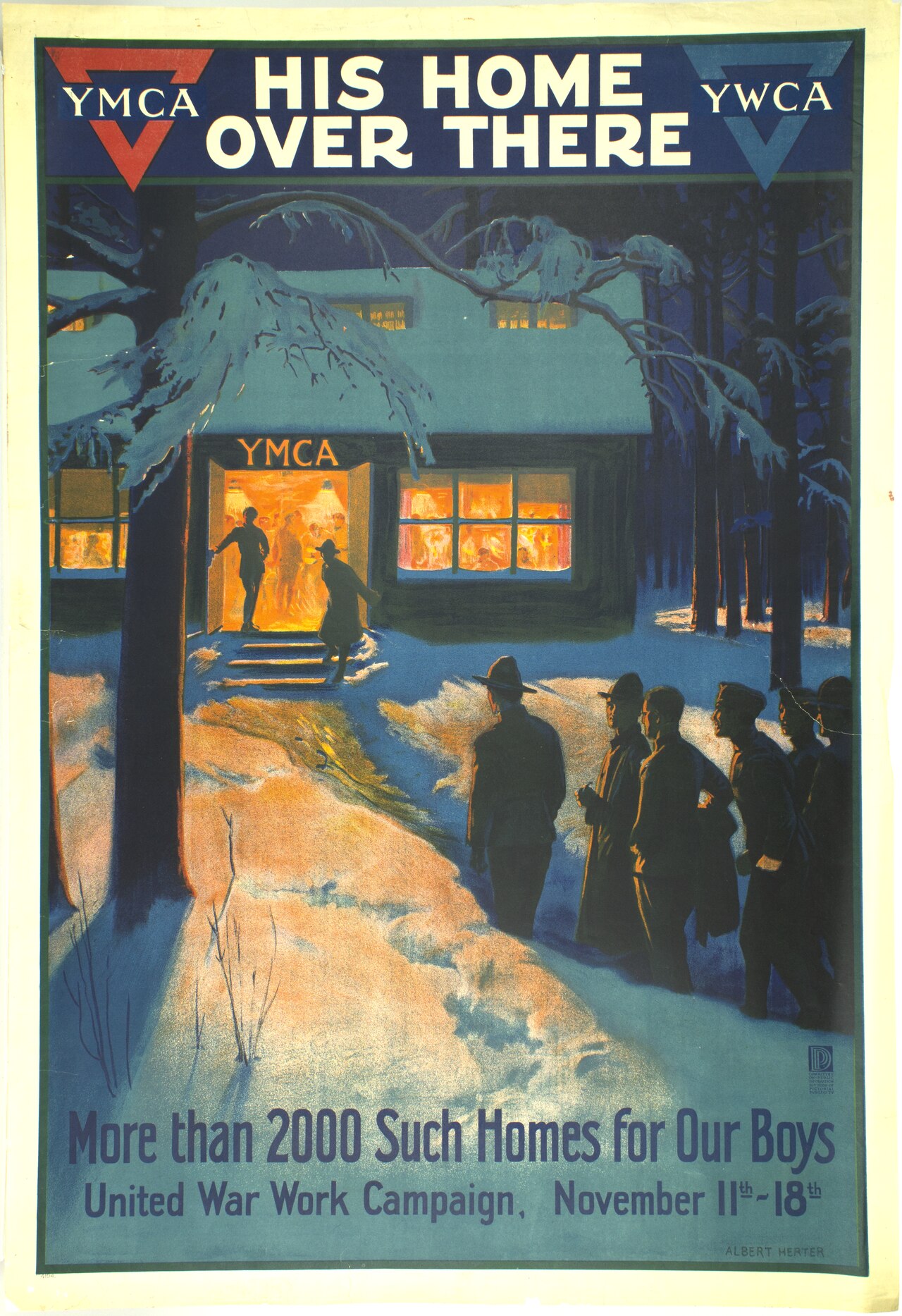
Major works - **Le Départ des poilus, août 1914 (1926)** – Completed after the First World War, this large mural commemorates the departure of French infantrymen in August 1914. The composition balances a poignant narrative with Herter’s characteristic decorative treatment, featuring a muted colour scheme and careful attention to the emotional tenor of the scene. - **Self‑Portrait in Costume of Hamlet (1900)** – This self‑portrait showcases Herter’s love of theatricality. Dressed as Shakespeare’s tragic prince, he adopts a dramatic pose while retaining the refined brushwork of his portrait practice. The work exemplifies his ability to merge personal identity with the performative aspects of costume. - **Woman with Red Hair (1894)** – An early genre painting, it portrays a young woman with striking red hair, rendered in soft pastel tones. The piece reflects Herter’s early fascination with colour harmony and his skill at capturing delicate facial expression. - **His Home Over There YMCA YWCA (1918)** – A series of mural panels created for the YMCA/YWCA during the First World War, this project illustrates domestic and communal scenes that celebrate the supportive role of these organisations. The murals integrate architectural motifs with narrative content, demonstrating Herter’s capacity to fuse decorative design with social commentary.
Influence and legacy Albert Herter’s work occupies a distinctive niche in American art history, bridging the academic traditions of the 19th century with the decorative ambitions of the Aesthetic movement. His murals, in particular, contributed to the development of public art in the United States, influencing later muralists who sought to combine narrative content with architectural integration. Although he never achieved the fame of contemporaries such as John Singer Sargent, Herter’s paintings and murals remain valuable for their technical proficiency and their illustration of a transitional period in American visual culture. His descendants continued his artistic lineage, most notably his son, the painter and muralist Herter, who further expanded the family’s contribution to American muralism. Today, Herter’s works are held in several museum collections and continue to be studied for their elegant synthesis of fine art and decorative design.
Frequently asked questions
Who was Albert Herter?
Albert Herter (1871–1950) was an American painter, illustrator, muralist and interior designer associated with the Aesthetic movement.
What artistic style or movement did he belong to?
He worked within Aestheticism, blending academic realism with decorative motifs and an emphasis on visual harmony.
What are his most famous works?
His best‑known pieces include the mural *Le Départ des poilus, août 1914* (1926), the *Self‑Portrait in Costume of Hamlet* (1900), *Woman with Red Hair* (1894) and the wartime mural series *His Home Over There YMCA YWCA* (1918).
Why is Albert Herter important in art history?
He exemplifies the transition from 19th‑century academic painting to early 20th‑century decorative art, influencing public mural practice and illustrating the American embrace of Aesthetic ideals.
How can I recognise an Albert Herter painting?
Look for a refined, pastel palette, meticulous draftsmanship, elegant decorative borders, and a smooth glazing technique that creates a luminous, harmonious surface.