Adriaen Coorte
1659 – 1707
In short
Adriaen Coorte (1659–1707) was a Dutch Golden Age painter from Middelburg, recognised for his modest, intimate still‑life paintings of fruit, shells and simple objects, signed between 1683 and 1707.
Notable works


Early life Adriaen Coorte was born in 1659 in the port town of Middelburg, a centre of trade in the Dutch Republic. Little is recorded about his family or education, but the artistic environment of the province of Zeeland offered opportunities for apprenticeship. It is probable that he entered the workshop of a local master, perhaps a still‑life specialist, where he would have learned the fundamentals of drawing, composition and the handling of oil paint.
Career and style Coorte began signing his canvases in the early 1680s, a period when the Dutch still‑life genre was moving towards greater opulence and elaborate banquet scenes. In contrast, his work retained a restrained aesthetic, favouring small‑scale compositions that placed a single object or a modest grouping on a plain surface. The simplicity of his arrangements recalls the early‑seventeenth‑century tradition of “intimate” still lifes, making Coorte one of the last practitioners of this pared‑back approach. His paintings are characterised by a muted palette, careful modelling of light, and an almost scientific observation of texture.
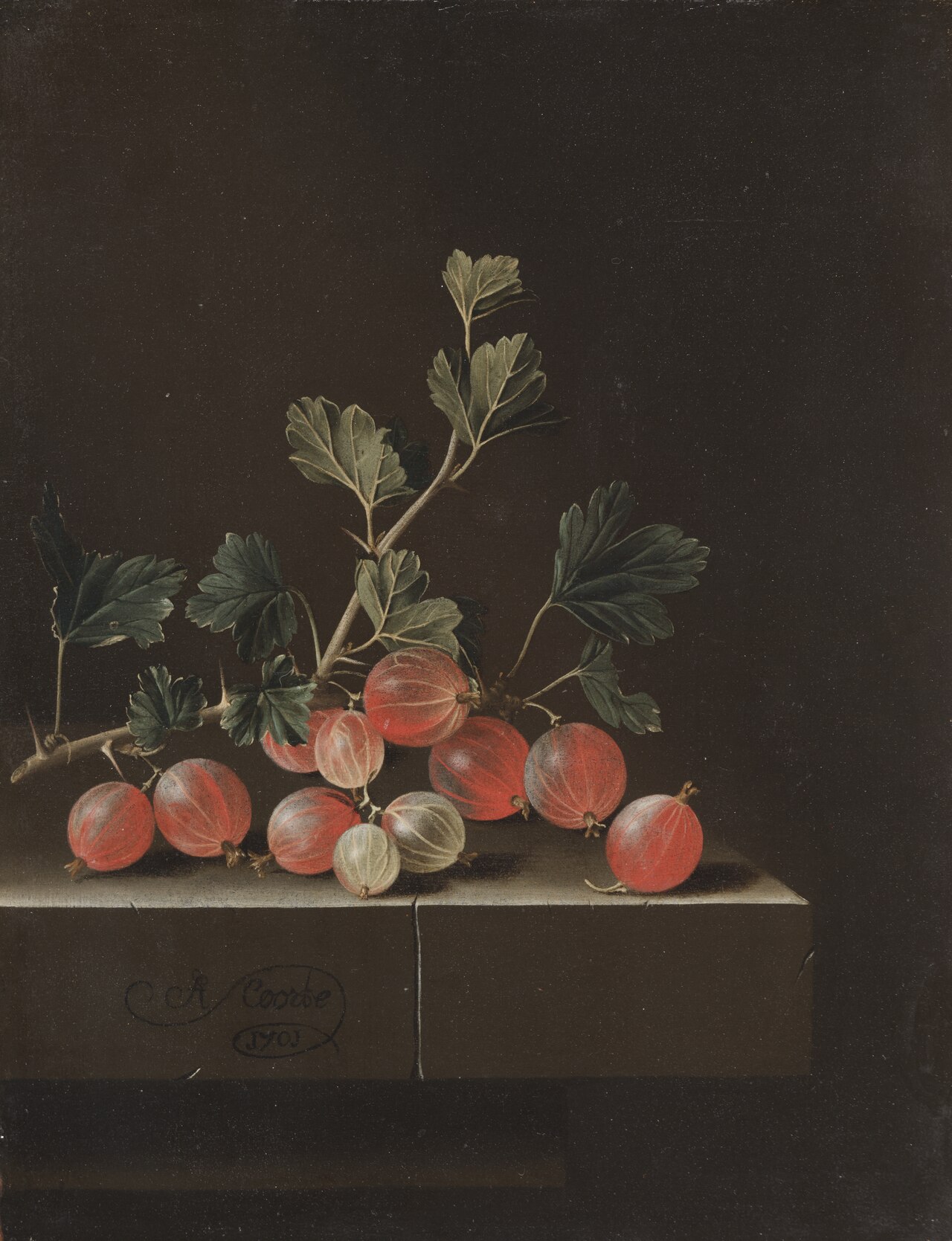
Signature techniques Coorte’s technique is distinguished by several recurring elements. He favoured a limited colour range, often employing earth tones, muted greens and subdued reds that enhance the natural colour of the subject. Light is rendered with a soft, diffused quality, creating subtle shadows that give objects a three‑dimensional presence without dramatic chiaroscuro. The artist painted on small wooden panels, which contributed to the intimate scale of his works. Brushwork is fine and controlled; he built forms through thin layers of glaze, allowing underlying tones to influence the final hue. The compositions are typically asymmetrical, with a single focal object placed off‑centre, leaving much of the background empty, thereby drawing the viewer’s eye to the tactile details of the subject.
Major works Among Coorte’s surviving oeuvre, a handful of pieces illustrate his mature style. *Still Life with Two Large and Four Smaller Shells* (1696) presents a modest arrangement of marine shells on a plain stone slab, the shells rendered with meticulous attention to texture and translucency. *Still Life with Strawberries* (1705) shows a cluster of ripe strawberries perched on a simple wooden board, their red flesh contrasted with the subdued background, exemplifying his skill in rendering organic surfaces. In *Still Life with Asparagus* (1697), a few stalks of asparagus are placed on a stone plinth, the composition reduced to the essentials of line and colour. *A Bowl of Strawberries on a Stone Plinth* (1696) features a shallow bowl of berries that appears almost suspended, the stone surface providing a quiet counterpoint. Finally, *Gooseberries on a Table* (1701) depicts a modest pile of gooseberries on a plain tabletop, the muted lighting emphasizing their delicate skin. Each of these works demonstrates Coorte’s commitment to simplicity, his mastery of light, and his ability to convey the tactile qualities of everyday objects.
Influence and legacy Coorte’s paintings were largely overlooked after his death, remaining in private collections and seldom exhibited. It was not until the mid‑20th century that art historians began to reassess his contribution to Dutch still‑life painting. His work is now appreciated for its quiet intensity and for representing a distinct strand of the genre that resisted the prevailing trend towards lavish banquet scenes. Contemporary artists who explore minimalism and the materiality of everyday objects cite Coorte as a subtle precursor. The renewed interest in his oeuvre has led to exhibitions, scholarly publications and a re‑evaluation of his place within the Dutch Golden Age, confirming his status as a unique voice that bridged early‑century intimacy with the emerging sensibilities of the later 17th century.
Frequently asked questions
Who was Adriaen Coorte?
Adriaen Coorte was a Dutch Golden Age painter (1659–1707) from Middelburg, known for his small, restrained still‑life paintings of fruit, shells and simple objects.
What style or movement is Coorte associated with?
Coorte worked in a modest, intimate still‑life style that echoes early‑17th‑century Dutch still lifes, rather than the more elaborate banquet scenes of his contemporaries.
What are his most famous works?
His most cited works include *Still Life with Two Large and Four Smaller Shells* (1696), *Still Life with Strawberries* (1705), *Still Life with Asparagus* (1697), *A Bowl of Strawberries on a Stone Plinth* (1696) and *Gooseberries on a Table* (1701).
Why does Coorte matter in art history?
Coorte is significant because he preserved a quiet, intimate approach to still‑life painting at a time when the genre was becoming more lavish, offering a unique perspective on the material world and influencing later minimalist tendencies.
How can I recognise a Coorte painting?
Look for small‑scale works on plain panels, a limited colour palette, soft diffused lighting, simple compositions that focus on a single object or modest grouping, and meticulous rendering of texture.