Adolph Alexander Weinman
1870 – 1952
In short
Adolph Alexander Weinman (1870–1952) was a German‑born American sculptor renowned for his architectural sculpture and iconic coin designs, most famously the Walking Liberty half dollar. He created public monuments such as the Lincoln statue in the U.S. Capitol and contributed significantly to early‑20th‑century American art.
Notable works

.jpg)


Early life Adolph Alexander Weinman was born on 12 September 1870 in Durmersheim, a small town in the Grand Duchy of Baden (now Germany). His family emigrated to the United States in 1888, settling in New York City where the young Weinman began his artistic training. He first attended the Cooper Union in Manhattan, studying drawing and modelling, before moving to the Art Students League, where he encountered the teachings of the American Beaux‑Arts tradition. Seeking a broader European perspective, Weinman returned to Germany to study at the Academy of Fine Arts in Munich, where he was exposed to classical sculpture and the emerging Art Nouveau style.
Career and style Back in New York at the turn of the century, Weinman entered the studio of Augustus Saint‑Gaudens, the leading American sculptor of the era. Under Saint‑Gaudens he learned the rigour of large‑scale public commissions and the importance of integrating sculpture with architecture. Weinman quickly established his own practice, receiving commissions for both decorative architectural panels and independent monuments. His style blended the Beaux‑Arts emphasis on idealised form with a restrained naturalism, often employing a modest degree of allegorical symbolism. Though he never aligned himself with a single avant‑garde movement, his work reflects the transitional period between historicist classicism and the more expressive currents of the 1920s.
Signature techniques Weinman's technical repertoire was grounded in traditional modelling in clay and wax, followed by fine carving in marble or casting in bronze. He favoured a smooth, almost polished surface finish that conveyed a timeless quality. In his architectural reliefs, he employed a low‑relief (bas‑relief) approach, allowing sculptural narratives to complement rather than dominate the surrounding structure. For his coin designs, Weinman mastered the reduction process, creating large‑scale models that were then reduced to the minute dimensions required for minting. His attention to detail ensured that even at the small scale of a half dollar, the design retained depth and dynamism.
Major works ### Walking Liberty half dollar (1916‑1947) Perhaps Weinman's most widely recognised work, the Walking Liberty half dollar was minted from 1916 to 1947. The obverse features a full‑length figure of Liberty striding forward, a motif that captures both optimism and motion. The reverse shows an eagle perched on a mount, its wings partially spread, symbolising strength and vigilance. The design was praised for its artistic merit and remains a favourite among collectors and historians alike.
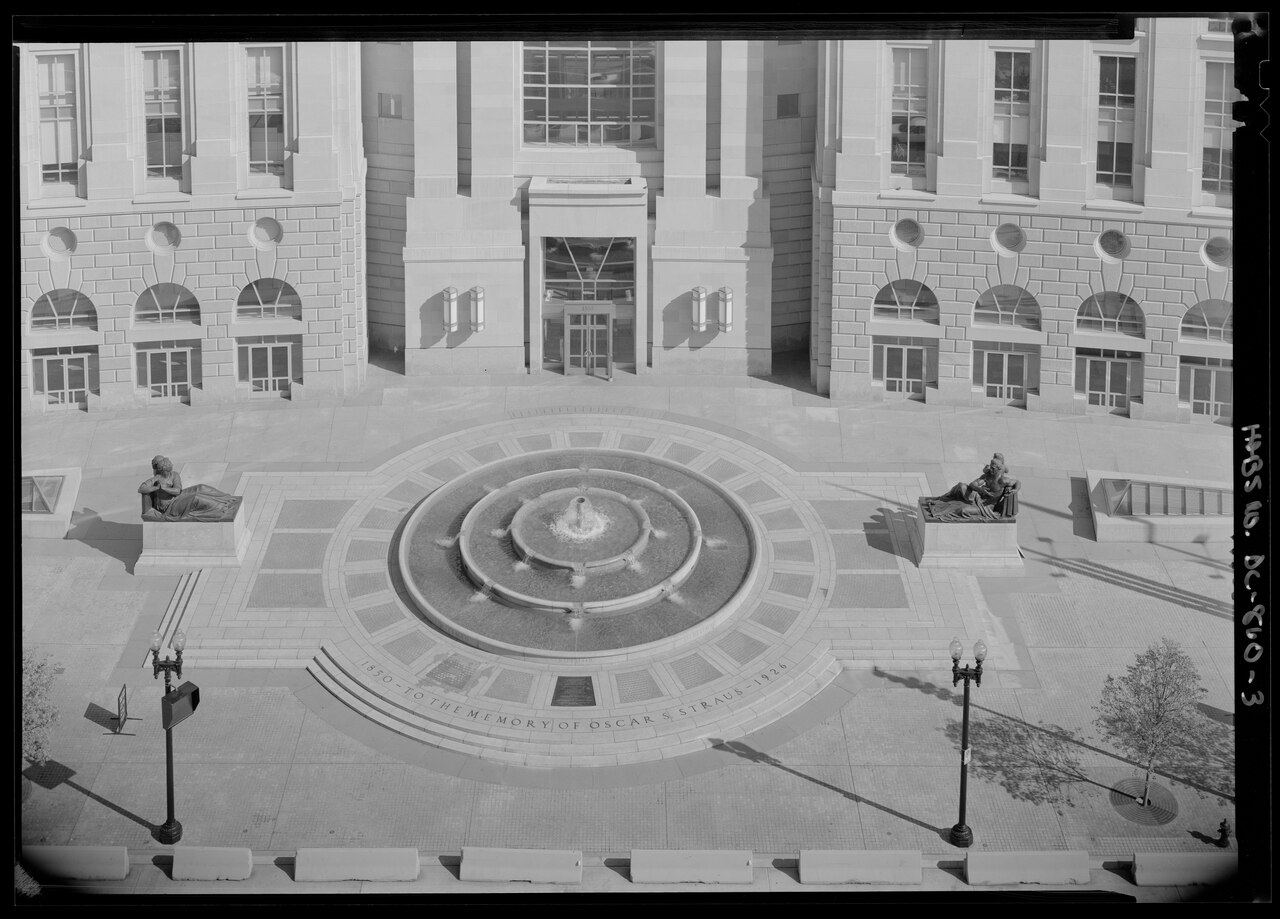
### Oscar Straus Memorial (1947) Commissioned to honour Oscar S. Straus, the first Jewish United States cabinet member, the memorial in Washington, D.C., combines a bronze portrait bust with architectural elements. Weinman's restrained yet dignified treatment reflects the subject's public service while integrating subtly symbolic motifs drawn from Straus's diplomatic career.
### Statue of Abraham Lincoln (1909) Located in the United States Capitol, this marble statue presents Lincoln seated, his gaze contemplative. Weinman's rendering emphasises the former president’s moral gravitas without resorting to overt heroics. The work aligns with the Capitol’s tradition of commemorating national figures through idealised yet approachable forms.
### Statue of Alexander Macomb (1906) Erected in front of the U.S. Treasury Department, the bronze statue of General Alexander Macomb honours the War of 1812 hero. Weinman's composition places the general in a commanding pose, his uniform detailed with careful attention to historical accuracy, reflecting the sculptor’s commitment to both artistry and documentary fidelity.
### Union Soldiers and Sailors Monument (1909) This monument in New York City commemorates the Union forces of the Civil War. Weinman's design integrates bronze figures of a soldier and a sailor, each rendered with realistic anatomy and expressive posture. The figures stand atop a granite pedestal, creating a balanced visual dialogue between the two branches of service.
Influence and legacy Adolph Weinman's career spanned the transition from 19th‑century academic sculpture to the more experimental aesthetics of the early 20th century. His public monuments contributed to the visual vocabulary of American civic spaces, and his coin designs set a high standard for numismatic art. As a teacher at the National Academy of Design, he mentored a generation of sculptors who inherited his emphasis on craftsmanship and integration with architecture. Though not associated with a single avant‑garde movement, Weinman's body of work remains a testament to the enduring power of classical form adapted to modern American themes. His pieces continue to be exhibited in major museums, and the Walking Liberty half dollar is celebrated as an iconic example of American design excellence.
Frequently asked questions
Who was Adolph Alexander Weinman?
Adolph Alexander Weinman (1870–1952) was a German‑born American sculptor best known for his public monuments and the celebrated Walking Liberty half‑dollar coin.
What artistic style or movement is Weinman associated with?
Weinman's work reflects a blend of Beaux‑Arts classicism and restrained naturalism; he did not belong to a single avant‑garde movement but worked within the academic tradition of his time.
What are his most famous works?
His most famous works include the Walking Liberty half dollar, the Lincoln statue in the U.S. Capitol, the Alexander Macomb bronze, the Union Soldiers and Sailors Monument, and the Oscar Straus Memorial.
Why is Weinman important in art history?
Weinman helped define early‑20th‑century American public sculpture, set a high standard for numismatic design, and influenced later sculptors through his teaching at the National Academy of Design.
How can I recognise a Weinman sculpture?
Weinman's sculptures are marked by smooth, polished surfaces, a balanced classical composition, and often a modest allegorical symbolism that integrates seamlessly with architectural settings.