Abraham Teniers
1629 – 1670
In short
Abraham Teniers (1629–1670) was a Flemish painter and engraver from Antwerp who specialised in genre scenes of rural life, taverns and mischievous monkey narratives. A member of the prominent Teniers family, he worked as both artist and publisher in the Habsburg Netherlands.
Notable works
.jpg)


.jpg)
Early life Abraham Teniers was born in Antwerp in 1629 into the well‑known Teniers artistic dynasty. His father, David Teniers the Elder, was a respected painter and art dealer, and his older brother, David Teniers the Younger, would become one of the leading genre painters of the Dutch‑Spanish Netherlands. Growing up in a household saturated with art workshops, apprenticeships and commercial dealings, Abraham received his initial training within the family studio. The Antwerp Guild of Saint Luke, which regulated artistic practice in the city, provided the formal framework for his apprenticeship, although precise registration details are lacking. The bustling commercial environment of 17th‑century Antwerp, a hub for both local patrons and foreign merchants, offered abundant opportunities for a young artist to observe market tastes and develop a pragmatic approach to his craft.
Career and style By the early 1640s Abraham had begun to establish himself as an independent painter. His oeuvre centres on genre subjects—scenes of everyday life in villages, inns, and market squares—rendered with a light‑hearted, narrative tone. While his brother David the Younger pursued a more refined, courtly aesthetic, Abraham favoured a robust, rustic style that appealed to the middle‑class market. He frequently incorporated animals, especially monkeys, into his compositions, a sub‑genre known as "singerie" that allowed for moralising satire cloaked in humour. The inclusion of monkeys behaving like humans—drinking, playing cards, or attending a barber’s shop—served both as a visual gag and a subtle commentary on human folly.
Abraham was also active as an engraver and publisher. He produced a series of prints after his own designs and after those of his brother, helping to disseminate the Teniers brand across the Low Countries and beyond. This dual role as painter‑engraver reflects the commercial adaptability that characterised many Antwerp artists of the period, who balanced the creation of original works with the production of reproducible images for a wider audience.
Signature techniques Abraham Teniers employed several technical hallmarks that help to identify his hand. Firstly, his brushwork is generally brisk and confident, with a slightly impastoed handling of foliage and textiles that conveys texture without sacrificing overall cohesion. He favoured a warm, earthy palette—ochres, burnt siennas, and muted greens—punctuated by brighter accents such as the reds of a tavern banner or the vivid plumage of a bird. In his monkey scenes, the animals are rendered with a high degree of anatomical observation, yet their expressions are exaggerated to heighten the comic effect.
Compositionally, Teniers often placed the principal action in the foreground, using a shallow depth of field to draw the viewer’s eye directly into the bustling centre of the scene. Architectural elements, such as low‑lying tavern roofs or village cottages, are rendered with a simplified perspective that reinforces the narrative rather than striving for strict realism. Light is typically sourced from a single, often window‑like, direction, creating chiaroscuro contrasts that model figures and give a sense of three‑dimensionality. In his engravings, he employed fine cross‑hatching to suggest texture, and he occasionally used stippling to render the fur of monkeys or the surface of fabrics.
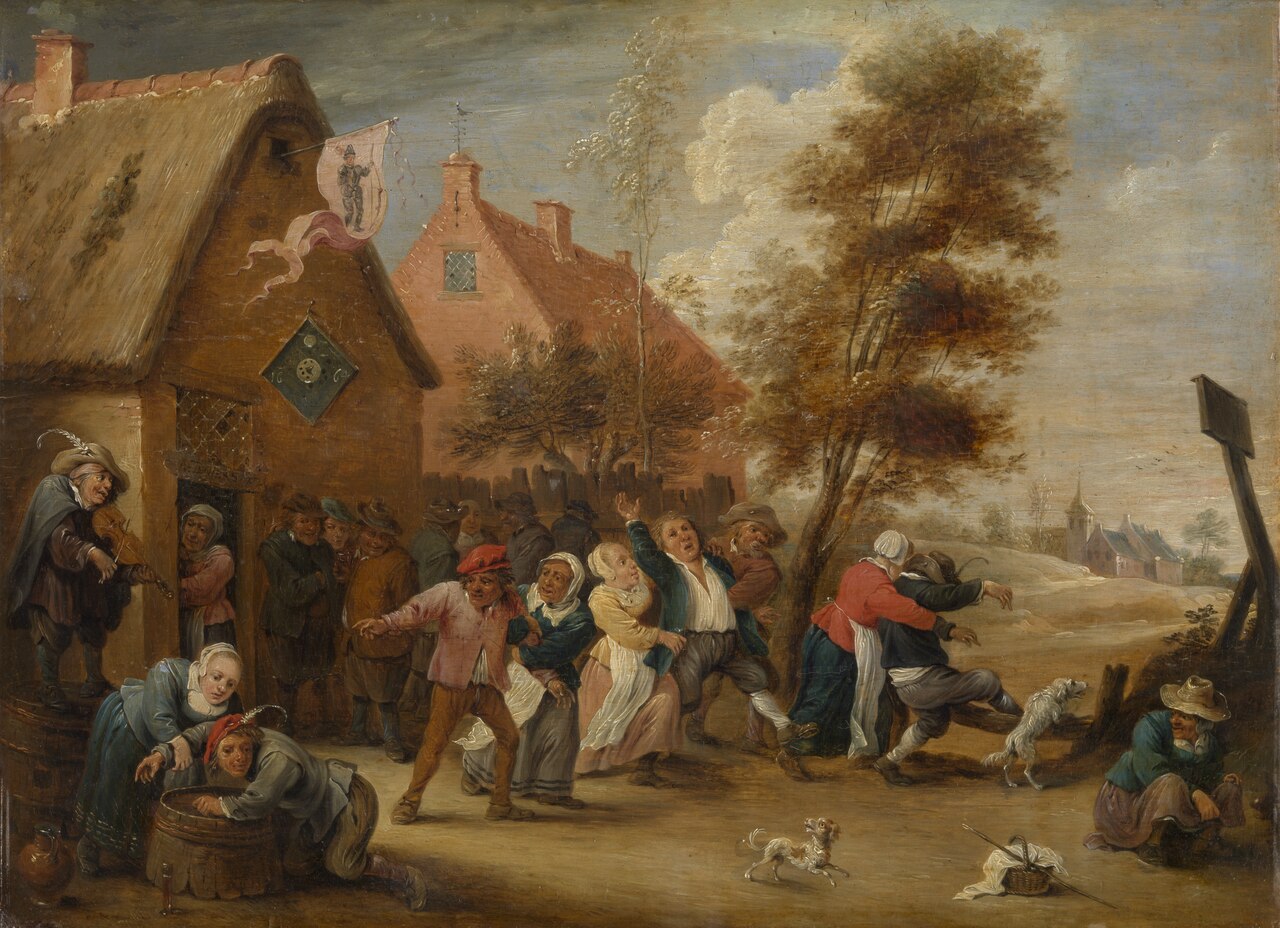
Major works - **Rural Feast (1641)** – One of his earliest dated works, this painting depicts a lively banquet set in a countryside inn. Peasants and servants mingle around a long table laden with roast meat, bread, and wine. The composition showcases Teniers’ talent for arranging multiple figures in a cohesive tableau, while the warm colour scheme conveys the convivial atmosphere of a Flemish village celebration. - **Dancing Peasants (1660)** – Executed later in his career, this canvas captures a group of villagers in motion, their bodies twisted in a rhythmic dance. The work exemplifies his skill in rendering dynamic movement and his continued interest in popular folk customs. The brushwork is looser than in his earlier pieces, reflecting a mature confidence in handling paint. - **Tabakskollegium with monkeys (1650)** – In this satirical genre scene, a group of men gathers to smoke tobacco while a troupe of monkeys imitates their gestures. The monkeys, dressed in miniature jackets, hold pipes and mimic the men’s gestures, creating a humorous parallel that comments on the pretensions of the social club. The piece is notable for its detailed rendering of both human and animal subjects and for the subtle moralising undertone typical of singerie. - **Barbershop with monkeys and cats (1650)** – Another example of his singerie, this work shows a barber’s shop where monkeys and cats assist the barber. The animals are depicted with careful anatomical study, yet their mischievous expressions provide comic relief. The composition balances the bustling interior with a clear focal point on the barber’s chair, demonstrating Teniers’ command of interior space. - **Le Corps de Garde (1650)** – This painting portrays a guard unit in a courtyard, rendered with a degree of formality that contrasts with his more playful scenes. While the subject is militaristic, Teniers still imbues the figures with a narrative quality, hinting at the everyday lives behind the uniformed exterior. The work illustrates his versatility in handling both light‑hearted and more sober themes.
Influence and legacy Abraham Teniers never achieved the fame of his brother David the Younger, yet his contributions to genre painting and the singerie tradition remain significant. By integrating comedic animal figures into everyday settings, he helped popularise a visual language that would be emulated by later Flemish and Dutch artists, such as Jan Brueghel the Younger and the French painter Jean-Baptiste Oudry. His prints, disseminated through his own publishing activities, extended the reach of the Teniers workshop, ensuring that the family’s stylistic signatures were recognised across the Spanish Netherlands and into the burgeoning art markets of Germany and England.
In modern scholarship, Abraham is often examined as a representative of the second‑generation Teniers, illustrating how artistic families adapted to changing tastes while maintaining a cohesive brand. His works provide valuable insight into the social customs of mid‑17th‑century Antwerp, especially the interplay between rural festivities and urban leisure activities. Though his name may be eclipsed by his more celebrated relatives, Abraham Teniers’ paintings continue to be displayed in European museum collections, and his prints are studied for their technical proficiency and their role in the diffusion of Flemish genre imagery.
Overall, Abraham Teniers exemplifies the industrious, market‑oriented artist of the Habsburg Netherlands: a painter who balanced narrative charm with commercial savvy, leaving a modest but enduring imprint on the visual culture of his time.
Frequently asked questions
Who was Abraham Teniers?
Abraham Teniers (1629–1670) was a Flemish painter and engraver from Antwerp who specialised in genre scenes of village life, taverns and mischievous monkey narratives.
What artistic style or movement is he associated with?
He worked within the Flemish Baroque tradition, focusing on genre painting and the singerie sub‑genre that uses monkeys to satirise human behaviour.
What are his most famous works?
Key works include *Rural Feast* (1641), *Dancing Peasants* (1660), *Tabakskollegium with monkeys* (1650), *Barbershop with monkeys and cats* (1650) and *Le Corps de Garde* (1650).
Why does Abraham Teniers matter in art history?
He contributed to the spread of Flemish genre painting, popularised the singerie motif, and through his publishing activities helped disseminate the Teniers family’s visual style across Europe.
How can I recognise an Abraham Teniers painting?
Look for lively village or tavern scenes with warm earth tones, brisk brushwork, and often the presence of monkeys mimicking human actions, rendered with detailed anatomy and a humorous tone.